
His Divine Grace
Oṁ Viṣṇupāda
Śrī Śrīmad Bhaktiprajñāna Keśava Gosvāmī Mahārāja (center)
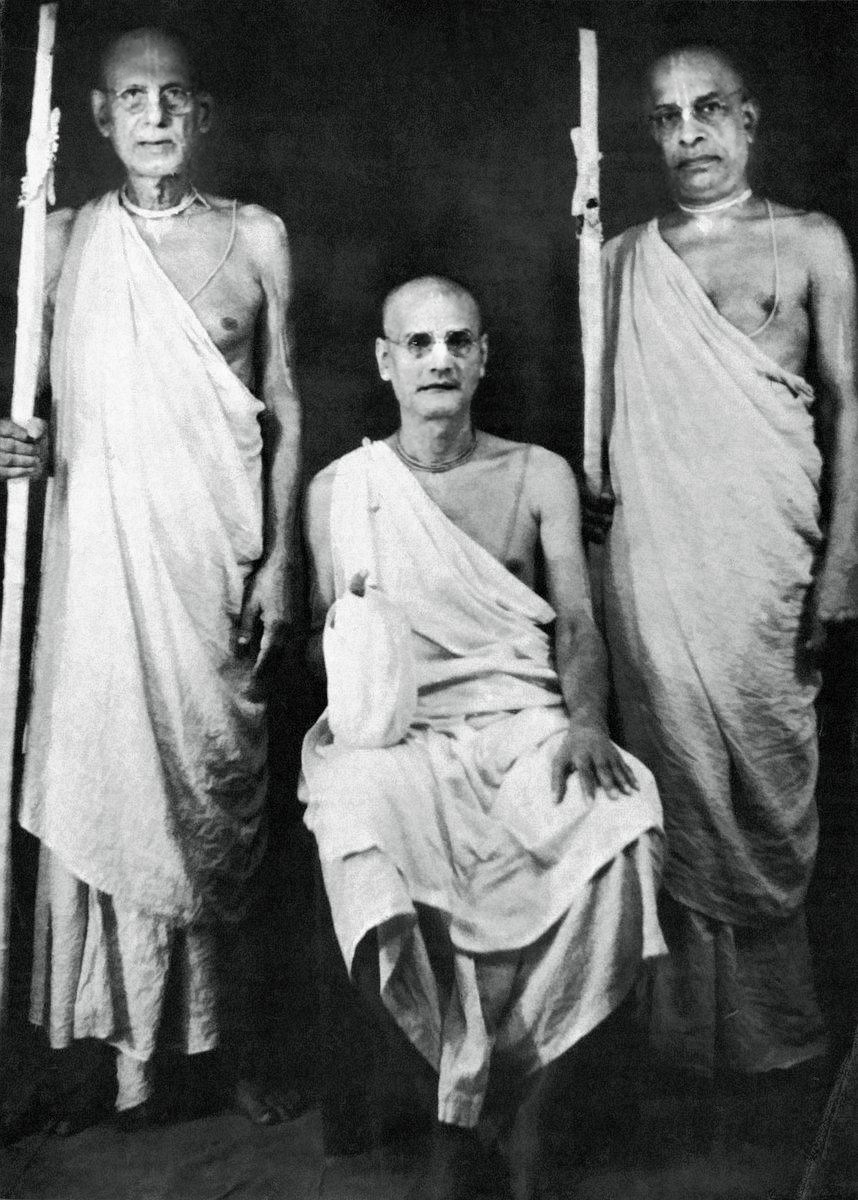
Śrīla Bhakti Prajñāna Keśava Mahārāja (center)
and his sannyāsa disciples,
Śrīla Bhaktivedanta Muni Mahārāj (left) and
Śrīla Bhaktivedanta Swami Prabhupāda (right)
Srila Prabhupāda Takes Sannyāsa On This Day In 1959
Śrīla A.C. Bhaktivedanta Swami Prabhupāda's
Disappearance Day Lecture In Honor of his Sannyāsa Guru
Śrī Śrīmad Bhakti-prajñāna Keśava Gosvāmī Mahārāj
Seattle, October 21, 1968
The following is a lecture given by Śrīla Prabhupāda in Seattle, Washington,
on
October 21,
1968, when he was informed that his sannyāsa-guru had departed from this world.
Prabhupāda: One has to accept the renounced order from another person who is in renounced order. So I never thought that I shall accept this renounced order of life. In my family life, when I was in the midst of my wife and children, sometimes I was dreaming my spiritual master that he's calling me, and I was following him. When my dream was over, I was thinking. I was little horrified. "Oh, Guru Mahārāja wants me to become sannyāsī. How can I accept sannyāsa?" At that time, I was feeling not very satisfaction that I have to give up my family and have to become a mendicant. At that time, it was a horrible feeling. Sometimes I was thinking, "No, I cannot take sannyāsa." But again I saw the same dream.
So in this way I was fortunate. My Guru Mahārāja (Prabhupāda begins to cry, choked voice) pulled me out from this material life. I have not lost anything. He was so kind upon me. I have gained. I left three children, I have got now three hundred children. So I am not loser. This is material conception. We think that we shall be loser by accepting Kṛṣṇa. Nobody is loser. I say from my practical experience. I was thinking that "How can I accept this renounced order of life? I cannot accept so much trouble."
So... But I retired from my family life. I was sitting alone in Vṛndāvana, writing books. So this, my Godbrother, he insisted me, "Bhaktivedanta prabhu..." This title was given in my family life. It was offered to me by the Vaiṣṇava society. So he insisted me. Not he insisted me. Practically my spiritual master insisted me through him, that "You accept." Because without accepting the renounced order of life, nobody can become a preacher. So he wanted me to become a preacher. So he forced me through this Godbrother, "You accept."
So unwillingly I accepted. And then I remembered that he wanted me to go to the Western country. So I am feeling now very much obliged to my, this Godbrother, that he carried out the wish of my spiritual master and enforced me to accept this sannyāsa order.
So this Godbrother, His Holiness Keśava Mahārāja, is no more. He has entered Kṛṣṇa's abode. So I wish to pass a resolution of bereavement and send them.
So... And I have composed one verse also in this connection in Sanskrit. So you all present, you sign this. I shall send it tomorrow. The verse I have composed, it is in Sanskrit. Vairāgya-vidyā-nija-bhakti-yogam [Cc. Madhya 6.254]. This Kṛṣṇa consciousness is vairāgya-vidyā. Vairāgya-vidyā means to become detestful to this material world. That is called vairāgya-vidya. And that is possible simply by this bhakti-yoga. Vairāgya-vidyā-nija-bhakti-yogam apāyayan mām. So this... Just like medicine. The child is afraid of taking medicine. That also I have experienced. In my childhood, when I became ill, I was very stubborn. I won't accept any medicine. So my mother used to force medicine within my mouth with a spoon. I was so obstinate. So anyway, similarly, I did not want to accept this sannyāsa order, but this Godbrother forced me. "You must." Apāyayan mām, he forcefully made me to drink this medicine. Anabhīpsu andham. Why I was unwilling? Anabhīpsu means unwilling. Andham, andham means one who is blind, who cannot see his future. The spiritual life is the brightest future, but the materialists cannot see to it. You see? But the Vaiṣṇavas, the spiritual master, they forcefully, "You drink this medicine." You see. Apāyayan mām anabhīpsu andhām śrī-keśava-bhakti-prajñāna-nāma.
So this my Godbrother, his name is Keśava, Bhaktiprajñāna Keśava. Kṛpāmbudhi. So he did this favor upon me because he was ocean of mercy. So we offer our obeisances to Vaiṣṇava, kṛpāmbudhi. Vāñchā-kalpa-tarubhyaś ca kṛpā-sindhubhya eva ca. The Vaiṣṇavas, the representatives of the Lord, they are so kind. They bring the ocean of mercy for distributing to the suffering humanity. Kṛpāmbudhir yas tam ahaṁ prapadye [Cc. Madhya 6.254]. So I am offering my respectful obeisances unto this His Holiness, because he forcefully made me adopt this sannyāsa order.
So he is no more in this world. He has entered Kṛṣṇa's abode. So I am offering my respectful obeisances along with my disciples. On the first day of my sannyāsa, I never thought, but I remembered that I'll have to speak in English. So I remember on that sannyāsa day, when there was a reception, so I, first of all, I spoke in English. So it is all arrangement of Kṛṣṇa, higher authority.
We are writing like this, "Resolved that we the undersigned members and devotees of International Society for Krishna Consciousness Incorporated, in a condolence meeting under the presidency of His Divine Grace A.C. Bhaktivedanta Swami, today the 21st of October, 1968, at our Seattle branch, express our profound bereavement on hearing the passing of His Divine Grace Oṁ Viṣṇupāda Śrī Śrīmad Bhaktiprajñāna Keśava Gosvāmī Mahārāja, the sannyāsa guru, preceptor of our spiritual master, and on October 6th, 1968, at his headquarter residence in Nabadwip, West Bengal. We offer our respectful obeisances unto the lotus feet of Śrī Śrīmad B. P. Keśava Gosvāmī Mahārāja with the following verse composed on this occasion by our spiritual master." This verse I have already explained to you. So I wish that you all sign this and I'll send it tomorrow by air mail.
Prabhupāda: Have you got pencil?
Govinda dāsī: Yes. (sound of Prabhupāda signing) (end)
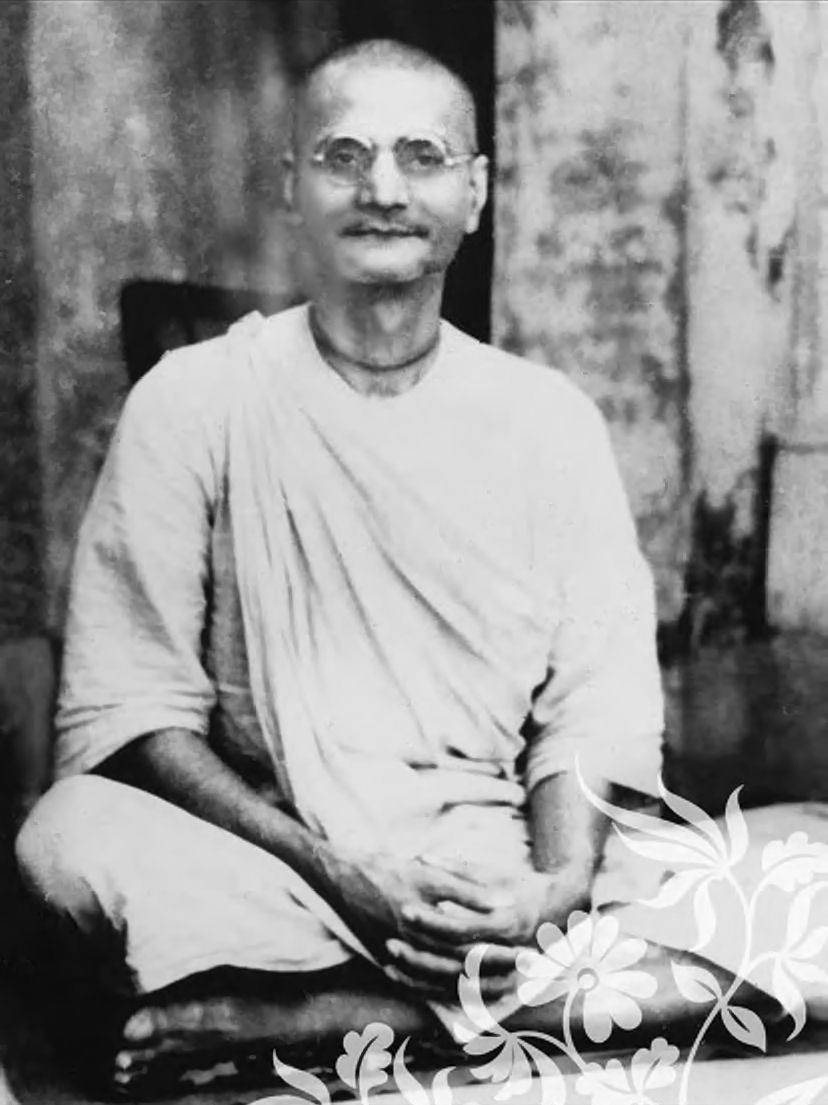
Śrīla Bhakti-prajñāna Keśava Praṇati
वैराग्य-विद्य-निज-भक्ति-योगम्
अपाययन् माम् अनभीप्सु अन्धाम्
श्री-केशव-भक्ति-प्रज्ञान-नाम
कृपाम्बुधिर् यस् तम् अहं प्रपद्ये
vairāgya-vidya-nija-bhakti-yogam
apāyayan mām anabhīpsu andhām
śrī-keśava-bhakti-prajñāna-nāma
kṛpāmbudhir yas tam ahaṁ prapadye
vairāgya—detachment from everything that does not help develop Kṛṣṇa consciousness; vidyā—knowledge; nija—own; bhakti-yoga—devotional service; apāyayan—has caused to drink; mām—me; anabhīpsu—unwilling; andhām— a blind person; śrī-keśava-bhakti-prajñāna-nāma—Named Śrīla Bhakti Prajñāna Keśava Mahārāj; kṛpā-ambudhiḥ—the ocean of transcendental mercy; yaḥ—who; tam—unto Him; aham—I; prapadye—I offer my respectful obeisances.
“I was completely blind, unwilling to drink the medicine of Kṛṣṇa Consciousness, which is endowed with knowledge of transcendental detachment from the material world. But my godbrother Śrī Bhakti-prajñāna Keśava Mahārāj forcefully made me drink this medicine. He showed this favor upon me because he is an ocean of mercy. I offer my respectful obeisances unto Him.”
“Eulogy in Sanskrit Verse” composed on October 21st, 1968, by His Divine Grace A.C. Bhaktivedanta Swami Prabhupāda in honor of the disappearance of his god brother and sannyās guru Śrī Śrīmad Bhakti-prajñāna Keśava Gosvāmī Mahārāj.