
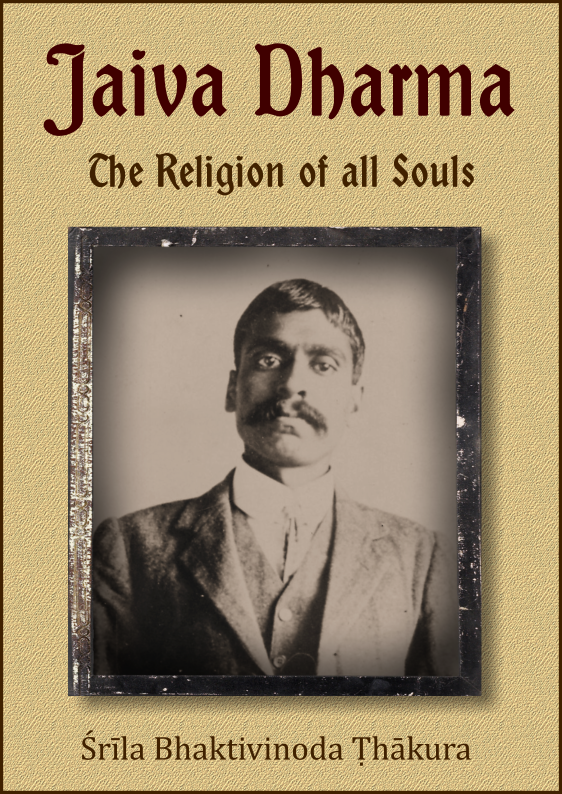
JAIVA DHARMA
- the religion of all souls -
By: Bhaktivinoda Ṭhākura
(original text from the HARMONIST)

Jaiva Dharma
CHAPTER III
The conditioned function of the jiva
is imperfect, unwholesome, adulterated and transitory.
1. One night, at the end of the first quarter, as Sanyasi Thakur, seated on a knoll in a remote corner of the grove of Sree Godroom, was chanting the Name of Hari, he happened to cast his glance towards the North. The full moon had then risen in the eastern horizon displaying far and wide the charming beauty of the circle of Navadwip. Sree Mayapur presently came within his view. It appeared to be not very far from the place where he was sitting. Sanyasi Thakur was amazed at what he saw. He mechanically muttered within himself, "Oh, what a wonderful Abode I see yonder ! It gives me ineffable delight. Streams of light issuing from lofty edifices, temples and arched gateways, all made of jems, are flooding the country-side along the banks of the Ganges. In many places the tumultuous sound of congregational chant of the Name of Hari is rending the firmament. Hundreds of devotees, resembling Narada, are singing and dancing in ecstatic joy to the music of the guitar and mridanga. At one place Mahadeva, god of the gods, the colour of whose body is spotless white, is dancing in a vigorous and unrestrained manner, to the music of his dambaru held in his right hand. He falls to the ground ever and anon crying all the time, "O Vishwambhara, have mercy on me". At another place the four-faced Brahma is giving to the assembly of the Vedic sages clear expositions of the Vedic hymns, "That Purusha (the Absolute Person) is the Supreme Lord (Mahaprabhu). He is the Originator of our intelligence. By His Grace unalloyed peace can be had. He is the only Guide and is eternal and unchangeable". On another spot all the gods headed by India are bounding with joy as they shout, "All Glory to Gaurachandra, all Glory to Nityananda !" The birds, perched on the branches of the trees, are singing the Names of "Gaura-Nitai", in praise. The bees, drunk with the honey of the Name of Gaurasundara, are humming on all sides in the flower-gardens. The goddess of Nature, frenzied with the liquid sweetness of Gaurachandra, is broadcasting her beauty and loveliness all around. "How wonderful !" exclaimed Sanyasi Thakur. "I never find these things when I see Mayapur at day time. What is this that I see to-day ?" Then he called to his mind the lotus feet of his Master and was evidently speaking to him, "Divine Master I have learnt the truth this day. You have enabled me out of mercy to have the sight of Mayapur, the Transcendental Abode of Godhead. I shall find the method by which I may introduce myself as Sree Gaurachandra's own from to-day. I see that in spiritual Navadwip all persons are decked with necklaces of tulasi beads, tilaka and letters of the Name. I also shall do the same". As he was speaking in this manner Sanyasi Thakur was reduced to a condition resembling the unconscious.
2. He came to his senses again in a short time. He recovered, indeed, his external consciousness but those spiritual happenings, which he had never experienced before, did no more come within range of his vision. Thereupon, Sanyasi Thakur began to weep and said, "I am most fortunate because by receiving the mercy of the Divine Master I have been blessed, even for a short time, with the vision of Sree Navadwipdham".
3. On the following day Sanyasi Thakur discarded his ascetic staff, which he now consigned to the water, and, having decked his neck with a three-stringed necklace of tulasi beads and his forehead with the upward tilaka mark, began to dance as he chanted aloud the Name of Hari. All the Vaishnavas, who abode in Godrooma, on beholding his new garb and condition for the first time, showered upon him their admiring congratulations and prostrated themselves humbly to his feet. At this Sanyasi Thakur felt a little embarrassed. He thought within himself, "Alas ! I have assumed the Vaishnava garb for deserving the mercy of the Vaishnavas. But it has brought this new risk. I have heard repeatedly from the lips of my Holy Master the Teaching of the Supreme Lord that one should chant the Name of Hari at all time by being humbler than a blade of grass and more forbearing than a tree, by giving all due honour to others without being honoured oneself (Ch. Ch. Antya. 20-21)".
4. "What will be my fate", he thought, "as the Vaishnavas whom I consider to be my superiors are now humbly bowing to me ?" Pondering this subject with great anxiety Sanyasi Thakur made his way to Paramahansa Babaji and prostrated himself at the feet of His Divine Master.
5. Seated under the awning of the Madhabi creeper Babaji Maharaj was chanting the Name of Hari. On noticing the complete change of garb and the appearance of love for the Name, Babaji Maharaj embraced his disciple bathing him with his tears of love. He then said, "Vaishnavadasa, I feel the satisfaction of the fulfilment of all my desires by touching your body which is charged with all auspicious quality".
6. As soon as these words were spoken the former name of Sanyasi Thakur was removed and he became known by his name of Vaishnavadasa. From this day Sanyasi Thakur realised a unique life. All his vanities of pantheistic asceticism, his conceited name of impersonal asceticism, his garb of a mayavadi sanyasi and his ideas about his own superiority, left him.
7. The same afternoon a good number of Vaishnavas, resident in Sree Godrooma and Madhyadwipa, came to the holy grove of Sree Pradyumna Brahmachari for the sight of Paramahansa Babaji. All of them are now seated in a circle around Paramahansa Babaji. All are mentally reciting the Name of Hari on the string of tulasi beads. Some of them are shedding tears as they give utterance to a variety of pious ejaculations--Ah Gauranga Nityananda ! O Sitanath ! Oh, Glory to Sachinandan ! All the Vaishnavas are talking among themselves in performance of their confidential associated service (Isthagosthi). The assembled Vaishnavas are prostrating themselves to one another after gyrating the sacred tulasi. Presently Vaishnavadasa also comes to the place and, after gyrating Sree Vrindadevi, begins to roll on the holy dust sanctified by the touch of the feet of the pure devotees. Some of those great souls speak in whisper among themselves, 'Is he not the same of Sanyasi Thakur! How wonderful does he look today !'
8. As he rolls on the ground in the presence of those devotees, Vaishnavadasa makes this humble confession, "I realise to-day the object of my life by receiving the dust of the feet of the Vaishnavas. By the mercy of my Divine Master I have been able to understand very well that there are no other means for the good of the soul than the dust of the feet of the Vaishnavas. The dust of the feet of the Vaishnavas, the nectar of their feet-wash and that of the remains of food touched by their lips, these three things are the medicine of the disease of worldliness as well as the only wholesome diet for patients suffering from the disease of mortality. It not only completely cures the disease of worldliness but it also enables all persons who are fully free from the disease to obtain the supreme object of their highest enjoyment. Most revered Vaishnavas, may you have mercy upon me that I may not suppose that to-day I am also expressing only the vanity of my learning. During these days my heart has become free from all vanities. I was born in a Brahmana family. I studied all the Shastras. I entered the fourth asrama viz., of the ascetic order. During all that time my vanity knew no bounds.. From the moment I have been attracted towards the principle of the Vaishnava Religion a seed of humility has been planted in my heart. I have been able step by step by your mercy to discard the vanities of high birth, learning and the exalted position of an ascetic. At present I feel that I am an insignificant, helpless creature. There is no other course open to me for my good than seeking the refuge of the feet of the Vaishnavas. The state of a Brahmana learning and asceticism were slowly but surely leading me on the downward path of degradation. I have confessed at your feet everything frankly as I feel. May you be pleased to deal with your servant in any way that you like."
9. On hearing the humble confession of Vaishnavadasa most of the assembled devotees gave vent to their feeling in the following words, "Great servant of the Supreme Lord, we have been eagerly seeking for the dust of the feet of Vaishnavas like your good self. May you be pleased to fulfill the object of our life by mercifully bestowing on us the dust of your feet. You have been the recipient of the mercy of Paramahamsa Babaji. May you be pleased to purify us by bestowing on us the privilege of your company. It is recorded in the Brihannaradiya Purana that one attains devotion to the Feet of the Supreme Lord if one is blessed by association with such as you : "Bhakti ( spiritual serving aptitude ) verily manifests itself by the influence of association with the devotees of the Supreme Lord. Association with pure devotees is obtained as the result of accumulated good works performed during previous lives." We possess no doubt great stores of accumulated virtuous deeds congenial to devotion to our account, on the strength of which we have been able to obtain spiritual association with you. We are now filled with the hope of attaining devotion to the feet of the Supreme Lord Shree Hari by the influence of your society."
1o. After this reciprocation of humility and prostrations of the Vaishnavas had been finished, high-souled Vaishnavadasa, taking his seat in a corner, added to the glory of the assemblage of the brotherhood of those pure devotees. The fresh rosary of tulasi beads for chanting the Name of Hari gleamed in his hand,
11. On that day there was also another fortunate person occupying a seat in that assembly. He had learnt the language and literature of Islam from childhood. With the help of this knowledge and by imitating the external mode of living of the Mohamedan rulers he had come to be recognised as a person of high social standing among the people. He was a native of Shantipur and a high-born Kulin Brahmin by caste. He was the owner of extensive landed properties and was specially skilled in conducting factious quarrels. Having enjoyed all these advantages for a long period he did not find them altogether pleasant. At last he had taken to the practice of chanting the Name of Hari. He had studied in his younger days the different modes and tunes of music under renowned experts from Delhi. By dint of his previous musical training he became also a kind of a leading person among groups who practised the chant of the Name of Hari in company. But although the Vaishnavas did not love his studied musical airs he did not hesitate to impress his musical greatness by occasional display of those airs, scanning the countenance of his companions for signs of admiration. After he had continued to be this for some time he began to experience a certain degree of pleasure in chanting the Name. Thereafter he came up to Shree Godrooma and took up his residence in one of the hermitages of the Vaishnava devotees, with the intention of joining in the chanting of the Name by the Vaishnavas of Shree Nabadwip. It was in the company of the Vaishnava in whose hermitage he was staying that he had come that day to the grove of the Shree Pradyumna Brahmachari where he was sitting under the awning of Malati and Madhabi creepers. Having observed the behaviour of the Vaishnavas among themselves and specially their humility, and listened to the words of Vaishnavadasa, he felt a number of doubts in his mind. As he happened to be an accomplished speaker he picked up courage to put the following question to that august assembly of the Vaishnavas.
12. His question was to this effect,--''The dharma Sastras (treatises containing the regulations for domestic and social life) compiled by Manu and other sages have declared the Varna of the Brahmanas as superior to that of all others. They have prescribed the performance of daily worships and recitals, in the morning, noon and evening, as the eternal (nitya) duty of Brahmanas. If those performances are eternal why then are the Vaishnava rules of life opposed to them ?"
13. The Vaishnavas have no liking for controversy. If any wrangling Brahmana had put such a question they would not have cared to answer it, for avoiding a useless quarrel. But as the enquirer in question was in the habit of singing the name of Hari the assembled devotees expressed their desire to learn the answer of the question from the lips of the revered Paramahamsa Babaji. Paramahamsa Babaji prostrated himself in submission when he heard the command of the Vaishnavas and said, "Revered sirs, if it meet your wishes Sree Vaishnavadasa, a great devotee, may give us the complete answer to the question. All the devotees expressed their approval of the proposal.
14. On hearing the words of his Gurudeva (Divine Master) Vaishnavadasa, with due appreciation of the blessing conveyed by them to himself, addressed the assembly after expressing his sense of humility. "I am the least among all creatures and destitute of every good quality. It is extremely improper for me to speak anything in this assembly of the most revered devotees to whom the Truth is perfectly known. But as the command of the Guru must always be obeyed with complete submission I shall attempt to answer the question to the best of my power in conformity with my recollection of the honeyed instructions from the lotus mouth of my Sree Gurudeva regarding the true principles, that I have had the good fortune of drinking in with my ears". With these words Vaishnavadasa, after rubbing the dust of the feet of Paramahmsa Babaji all over his body stood up before that holy assembly and spoke as follows.
15. "May Sree Krishna Chaitanya, Who is the All-blissful Supreme Lord, Whose effulgent aspect is Brahman, Whose partial immanent aspect is Paramatman, and Who is the support and source of all manifestations and blissful activities, inspire with pure intelligence ! The dharma Sastras by Manu and other sages have come to be honoured all over the world by reason of the fact that they seek to regulate human life by their injunctions and prohibitions in conformity with the Teaching of the Veda (revealed knowledge of the Ultimate Truth). The nature of man has a twofold characteristic. He may seek to be regulated by a standard. He may also seek to follow the impulse of his spontaneous liking. So long as human judgment remains subject to the deluding power the nature of man must necessarily be inclined to be regulated. When the judgment of man is freed from subjection to the deluding power the inclination for regulation automatically ceases. In its place the inclination for following one's natural liking is manifested. The disposition that seeks to follow its own spontaneous liking is the pure nature of the soul. It is naturally perfect, spiritual and absolutely free from all material contamination. The affinity of the soul who is unalloyed spirit, for matter is dispelled by the Will of Sree Krishna. So long as He wills otherwise this affinity for matter may at best tend to continue in the state of readiness for discontinuance. In that condition, when the affinity for worldly relationship is ripe for waining, the judgment of man is internally immune from material relationship ; or in other words, liberation of the body of the soul from the external casings of matter has not yet been actually effected. When the spiritual body of the soul is actually disengaged from the material casings the inclination of spontaneous liking of the unalloyed soul for Krishna is manifested both in the inner essence as well as in the uncovered spiritual form. The nature of the denizens of Braja is of the essence of spontaneous love. In the state, when worldliness has taken the turn towards attenuation, the soul, following the pure spontaneous loving disposition of the denizens of Braja, is internally proselytized into the path of loving devotion (raganuga). This is the supremely wholesome state for the soul. So long as this state has not yet been realised the judgment of man continues to show its affinity towards material entities. By the force of this habit the deluded soul mistakes this addition to material entities as the natural affinity of his real self. Pure love for the. Spiritual Object of Love is not manifested up till the disengagement of one's spiritual body from the material casings. "I and mine", these twin principles of egoistic consciousness, continue to act in a concentrated form towards material objects. Under the impression "this physical body is mine and this physical body is myself", love and repugnance respectively for persons and objects that minister to or retard the happiness of this physical body, are naturally generated. By being subjected to these likes and dislikes the deluded soul expresses bodily, social and moral liking and repugnance towards other entities according as he regards them as his friends or enemies. He now quarrels over mundane objects. He becomes subject to pleasure and pain by indulging his unnatural affinity towards gold and woman. Such is this temporary worldly sojourn (samsara). Through their addiction to the worldly sojourn souls, in fetters to the deluding power, wander in this world undergoing birth and death, and attaining as the fruits of their material activities high and low conditions on this mundane plane. To such souls spiritual love does not appeal as their birth-right. They cannot even conceive what such love is really like. Alas ! what a pity that the soul, who is by his essence an infinitesimal spirit, should forget that spiritual love is his own natural function and internal disposition, and that through such forgetfulness and being intoxicated with his unnatural addiction to mundane entities he should be enjoying his own degradation ! Almost all persons in this world are unprepared to admit this deplorable state as being really such.
16. The disposition that is identical with love is confined to the denizens of Braja. Its active existence is never possible in this world. But even the disposition that is attracted towards such love is also extremely rare in this world and altogether unfamiliar to fettered souls. It is a very rare occasion when, by the grace of pure devotees, the disposition of affinity for the path of love is manifested in the mind of any conditioned soul. It is both rare and most difficult to attain. Such disposition is withheld from this world.
17. But Godhead is Omniscient and All- Merciful. He took notice of the fact that the soul, entangled by the deluding power, was debarred from his spiritual aptitude. By what method was he now to attain his good ? By what provision would the soul, deluded by the mundane energy, be supplied with a means for obtaining the awakening of his lost memory of Krishna ? The soul could, of course, remember himself to be the servant of Krishna by association with the pure devotees. But there is no definite provision for the occurrence of such association with the pure devotees. Where was then the hope that such association will be available to all persons ? So people in general would be bereft of any chance of attaining Spiritual benefit if there were no chalked out path of regulation. From the Glance of Mercy of Godhead the Shastras accordingly manifested themselves. The sun of the Shastras, born of the Mercy of God, thereupon rose on the firmament of the Aryan intellect and promulgated the path of obedience to the Command of God to all the people.
18. The Veda is the first of the Shastras. In different parts of the Veda Shastra the doctrines of karma ( fruitive mundane good works), jnana (pursuit of the path of knowledge free from all mundane features) and spiritual service in the form of love were declared as the courses commanded by Godhead. Souls deluded by Maya (the power that imposes mundane conditions on the soul) happen to differ as regards their individual conditions. Some of them are extremely ignorant. Some are found to possess knowledge to a limited extent. Some are well versed in many matters. The Shastra commands each individual to follow a different course authorised by itself to suit the state of intelligence of each person. Adhikaras (spiritual eligibility) of individual souls are numerically speaking countless. But those infinite gradations of eligibility are divisible into three distinct groups by reference to their dominating characteristic. These distinctions are due to eligibility for karma, jnana or prema. The Veda Shastra lays down this threefold course to suit the different conditions of different individuals. The Veda has made authoritative regulations and thereby has fixed both the duties as well as prohibited activities of the three different groups. The dharma ( the function that is proper to one's nature ) that has been thus settled is called Baidha dharma ( dharma commanded by Godhead ). The inclination that leads the soul to obey the Divine Command is also called Baidhi. The person who is devoid of the Baidhi inclination is opposed to the Divine Law. Such persons are habitually given to sinful activities. The life of such a person is constantly devoted to the transgression of the Divine Command. He is designated by the terms Mlechha, etc., who are outside the pale of the Vedic Law. The threefold eligibility which has been defined by the Vedas is further elaborated by the Rishis in the Samhitas and other Shastras, in pursuance of the teaching of the Veda. Manu and other scholars have written about eligibility for karma in a series of twenty Dharma Shastras ( legal codes ). Those who profess empiric philosophical views have treated eligibility for the path of knowledge in the body of those Shastras that are devoted to logical controversies. The Pauranikas and unalloyed Tantrikas have laid down the practice and teaching of principles regarding eligibility on the path of bhakti (transcendental service). All these three paths belong to the Vedic dispensation. Modern interpreters of these different groups of Shastras have misled many a person into wrong controversy and the slough of doubts by their exaggerated descriptions, in isolated passages, of the complete excellence of a particular path by carelessly overlooking the significance of the whole body of the Shastras. If we look into the Geeta embodying the unique reconciliation of all those Shastras, we can understand that the karma which does not point to jnana should be discarded as being atheistical and opposed to the Veda. Moreover if karma and jnana do not point to bhakti both of them, by their misapplication to the Absolute degenerate into atheism. Karma, jnana and bhakti in their respective right applications to the summum bonum are essentially one and the sane path. This is the reasoned conclusion of the Vaishnava thought declared by the Veda.
19. The jiva, infatuated by the deluding power, betakes himself to karma in the first instance for supporting his mundane existence. Next comes karma-yoga when karma is performed with a view to transcendental realisation. Karma-yoga progresses into jnana-yoga, and last of all appears bhakti-yoga. The jiva, infatuated by the deluding power, has to progress through these successive stages in order to reach the temple of bhakti. He can never have any inclination for transcendental service except in terms of these successive stages. He cannot be made to understand by any other method the necessity of serving Godhead.
20. But what is exactly meant by the recourse of the jiva to karma ? Whatever activity is performed with the body and mind after being born in this world is karma. This karma is of two kinds--good and evil. By the performance of good karma the jiva reaps good consequences. By the performance of evil karma the jiva has to suffer bad consequences. Evil karma is also called 'papa' or 'bikarma'. The non-performance of good karma is called 'akarma'. Both of these are bad. Good karma alone is good for the soul. Good karma is again of three kinds viz. nitya, naimittika and kamya. Kamya karma or performance of work for the gratification of one's senses is negligible, as it is extremely selfish. Nitya and naimittika karmas are recommended by the Shastras. As a matter of fact the Shastras designate only nitya,naimittika and kamya karmas as karma, and refuse to recognise akarma and bikarma as karma. This preference of the Shastras is based upon the consideration of the wholesomeness or otherwise of the different types of karma. As kamya karma has also been left out for the reason that it is not wholesome, nitya and naimittika karma may, therefore, be considered to be the only varieties of karma according to the Shastras. Nitya karma is karma that is productive of benefits to the body, mind, society and life after death. Nitya karma should be performed by all persons, as a matter of duty. Those karmas that are occasionally performed in respect of some special occurrence, but as a matter of duty on a par with nitya karma, are called naimittika karma. Evening worship, salutation to God, maintenance of society and one's own body by pure means, truthful conduct and maintenance of one's dependants--all these are nitya karma. The performance of one's duty towards one's deceased parents, etc., and the performance of penance on the commission of 'papa'--these are naimittika.
21. Nitya and naimittika karmas should be performed in this world in the best possible manner. For making this obligatory on all persons the makers of the Shastras have prescribed a system of duties, which bears the name of varnashrama, after due consideration of the nature and diversities of the natural inclinations of man. The purport of the varnashrama system is as follows. Men who are eligible for the performance of karma, belong naturally to one of four distinct types. These types are designated by the terms Brahmana, Kshatriya, Vaishya and Shudra. The respective modes of life which they choose to lead in this world are also fourfold and are called ashram a or station. Grihastha (householder or family-man), Brahmachari ( whole-time worshipper ), Vanaprastha ( elderly person leading unworldly life ), and Sanyasi (a person who has completely renounced the world ), are the four stations. The varna or class of a person is ascertainable by the disposition, birth, activities and spiritual indications. In case the varna is ascertained only by the test of seminal birth, the only result is the loss of the real purpose of the institution. The stations have been instituted by reference to the states of married life, of celibacy and of repugnance towards the world consequent upon abandonment of sexual relationship. The station of the grihastha corresponds to that of the married life. The station of a person before marriage or of a celibate is that of the Brahmachari. The stations of Vanaprastha and Sanyas result from repugnance towards sexual connection. The station of Sanyas is the highest ashrama. The Brahmana is the highest varna.
22. The following true propositions have been established by Srimad Bhagavata, the crest-jewel of all the Shastras 11/17/15-21). The lower and higher natures of man result from the respective planes of the origin of the principles of his varna and ashrama. The regions of the leg and the loin in the body are the lower regions. The Shudra varna and the Grihastha ashrama have sprung from them. For this reason Shudras and persons inclined to domestic life possess the lower nature. Equanimity, self-control, asceticism, moral purity, inner satisfaction, forgiveness, straightforwardness, inclination to serve God, sympathy for the suffering of others, truthfulness--these are the nature of a Brahmana. Prowess, strength, coolness, heroism, patience, generosity, enthusiasm, steadfastness and fitness to rule-- these are the nature of a Kshatriya. Belief in God, constant desire for making charitable gifts, absence of duplicity, service of Brahmans and great endeavour for increasing one's store of wealth--these are the nature of a Vaishya. Personal service rendered to God, the twice-born and cattle and contentment with the wealth procured by such submissive service of God, the twice-born and cattle--these are the nature of a Shudra. Impurity, falsehood, theft, disbelief in life after death, quarrelsomeness, lust, proneness to sudden anger, desire for the evil course--all this constitutes the nature of the Antyajas who have fallen away from the natural modes of life. Absence of malice, truthfulness, non commission of theft, immunity from lust, sudden anger and covetousness, and endeavour for pleasing and doing good to all jivas --these are the natural duties of all the varnas.
23. In the assembly of spiritually enlightened person every one is in a position to realise the meaning of the words of the Shastras. So it is not necessary for me to explain the meaning of the text of the Bhagavata. I would, however, like to add that the provision of varna and ashrama is the basis of the life for obeying the commands of God. Irreligion comes to prevail in a country in a proportion as it happens to be more or less without the varnashrama organisation.
24. Let us now consider the nature of the application of the terms, "nitya" and "naimittika" to "karma". If we look the underlying significance of the Shastras we cannot resist the conclusion that those terms in their application to "karma" are not used in their spiritual sense. They are used in reference to "karma" with a mundane or transferred connotation. The terms 'nitya dharma,' 'nitya karma,' 'nitya tattva,' 'nitya satya' etc., can be properly used in reference to no other position except the unalloyed spiritual condition of the soul. Therefore, when the term 'nitya' is used in reference to 'karma' as a means to an end, we must understand that 'karma' which is distantly indicative of the eternal truth in this world is called 'nitya' only by reason of such reference. 'Karma' is never 'nitya' or eternal. It is only when 'karma' by the method of 'karma-yoga' is engaged in the quest of 'jnana,' and 'jnana' points to 'bhakti,' that 'karma' and 'jnana' are termed 'nitya' in a transferred sense. When the evening worship performed by a Brahmana is called 'nitya karma' it means no more than this that the method that has been laid down in regard to the material activities of our physical body, in as much as, it has a distant bearing on bhakti, is nitya as a means towards the realisation of the eternal function, and not because it is itself 'nitya'. Such application is known as 'upachara'.
25. In truth Krishna-prema or love for Krishna is the only eternal function of the soul. Its ontological nature may be stated as the activity of the unalloyed cognitive principle. Those material activities that are resorted to for the realisation of the spiritual function are performed towards the same end. Therefore, there is no harm if they are prescribed as eternal in this sense. From the absolute point of view it is better to call them 'naimittika' instead of 'nitya'. The distinctions of 'nitya' and 'naimittika' as applied to different varieties of 'karma' itself are for convenience and have no eternal significance.
26. In a consideration of the actual entity of things the exercise of the unmixed cognitive principle is admissible as the only eternal natural function of the individual soul. Every other function is accidental. Varnashrama (the duties of the varnashrama organisation), astanga-yoga ( the eight-fold yoga process ), sankhya-jnana (the path of materialistic knowledge) and tapasya (asceticism), all these are accidental functions. There would have been no necessity for all those functions if the individual soul had not been in bondage to Maya. On account of his having been fettered by Maya, the resulting infatuated state is itself one of the accidental causes. All those functions as the products of that accident, have thus become duties for the jiva. From the absolute point of view all of them are accidental functions.
27. The superior status of a Brahmana, his fruitive activities like the ritualistic practices of daily worship and prayers and assumption of sanyas (life of an ascetic by renunciation of family and society)--all these are accidental natural functions. These duties are held in esteem by the Dharmashastras (codes of social duty) and are most wholesome at the appropriate stages of spiritual pupilage. Yet they have no claim to one's regard as being on a footing with the eternal spiritual function. A shloka of the Bhagabat (Bhag. 7/9/9) runs thus: "Even the Chandala, feeding on the carcase of dogs, is better than a Brahmana, possessed of all the twelve good qualities, who is averse to the service of the Lotus Feet of Krishna. This is so because I hold that a person, whose mind, speech, all endeavours and wealth are dedicated to Krishna, sanctifies his family as well as his own life, whereas the Brahmana, although he is possessed of immense honour in society, cannot do so."
28. A Brahmana is distinguished above the other orders by his possession of the following twelve good qualities viz., truthfulness, control over his senses, austerity, freedom from malice, forbearance, freedom from envy, offering of sacrifice, offering of charitable gifts, constancy, listening to the Vedas and performance of vowed pious works. A Brahmana, endowed with these twelve good qualities, certainly commands the reverence of all persons in this world. But notwithstanding the possession of all these good qualities if he happens to be without devotional aptitude for Krishna, the All-attractive Supreme Lord, then even a dog-eating Chandala, who is possessed of spontaneous inclination to serve Krishna, must be held to be superior to him in every way. The real meaning of the shloka is that a person who, although born in a Chandala family, may resort to the cultivation of his spiritual nature, which is the eternal function of all pure souls (jiva), by being purified by constant association with the sadhus, is superior even to a Brahmana who, born in a Brahmana family may be assiduous also in the practice of the enjoined accidental functions but does not actively practise the eternal function in the shape of culturing his unalloyed spiritual nature.
29. In this world there are to be found two types of persons viz., those whose sense of right and wrong has been roused to activity and those in whom it is dormant. The world may be said to be almost full of the latter type. Persons whose ethical sense is properly aroused are extremely rare. A Brahmana is the highest among those whose ethical judgment is dormant ; and, therefore, the daily worships and prayers, that are the appropriate duties of persons endowed with the disposition of Brahmanas, are also the highest among the functions that are performed by this type of people. Persons, whose moral sense has been properly aroused to the state of activity, are also known as Vaishnavas. The conduct of Vaishnavas must necessarily present points of difference from that of persons whose sense of right and wrong is dormant. But although the conduct of the Vaishnavas happens to be different it is not opposed to the spirit of the Smarta rules that have been made for the guidance of persons with dormant ethical sense. The spirit of the regulations of the Shastras is the same in every case. Persons, whose moral sense is dormant, have been under the necessity of remaining confined to a particular portion of the elementary provisions of the Shastras. Persons, possessed of active moral sense, extend their friendly welcome to the spirit of the Shastras. There is no difference in spirit despite any difference in acts. To ineligible persons the conduct of persons with an awakened conscience has an appearance of being opposed to that of people in general. But as a matter of fact the underlying significance of even such apparently different conduct is one and the same.
3o. In the judgment of persons with properly awakened ethical faculties it should appear as quite proper to teach the accidental function to people in general. But the temporary function is nevertheless really imperfect, adulterated with unwholesome ingredients and impermanence.
31. The accidental function does not attempt the direct culture of our spiritual nature. In it the culture of the material principle is accepted in the form that is not incompatible with spiritual culture. Such function thus becomes no more than a means for the attainment of spiritual culture proper as the end. The means ceases to be followed on the production of its end. For this reason the means is also never complete in itself. The means is only a dissociated section of the truth of the thing which is the end. Hence the accidental function can never be perfect. For example the duties of daily worship and prayers of a Brahmana are temporary and dependant upon the observance of the proper rules in exactly the same way as his other secular duties. Those activities do not proceed from his natural spiritual disposition. After one has been accustomed to a course of such regulated activities for a long time, and when he comes to feel a liking for direct spiritual culture in the form of the chant of the Name of Hari by dint of the purification of his mind through active association with pure devotees, the duties of daily worship and prayer in the form of secular occupations are no longer necessary. The performance of the chant of the Name of Hari is complete spiritual culture. The performance of the daily prescribed worship and prayers is only a means for the attainment of the said end. Such performance never attains the characteristic of the complete activity.
32. The accidental function is adulterated with undesirable factors, notwithstanding the fact that it deserves to be esteemed for aiming at the true end. The spiritual principle is alone wholesome. Matter and association with matter are alone unwholesome for the individual soul. The accidental function contains a great proportion of the material principle. Moreover the said function brings forth such a profusion of irrelevant results that the soul cannot but get entangled in them, For instance it is certainly a good thing for a Brahmana to worship God, but a false egotism, in the shape of such beliefs as that "I am a Brahmana other souls are inferior to myself",--is apt to render the worship of a Brahmana productive of undesirable consequences. Similarly an objectionable bye-product of the eight-fold yogic function which goes by the name of "bibhuti" ( magical power ) is also extremely harmful to the individual soul. 'Bhukti' ( mundane enjoyment ) and 'mukti' (liberation) --these two are unavoidable companions of the accidental function. It is only if a person can save himself from the clutches of these fell enemies that he can have a chance of attaining the spiritual function proper which is the fundamental object of such activities. But we must bear it in mind that in the accidental function, for the purpose of the individual soul, the undesirable factor is preponderant.
33. The accidental function is impermanent. It does not hold at all times and in all conditions of the jiva. For instance the Brahma nature of a Brahmana, the Kshatra nature of the Kshatriya etc., are accidents ; they disappear as soon as the cause of them is exhausted. A person may be born a Chandala following his birth in a Brahmana family. In his second life the accidental function corresponding to his varna as a Brahmana is no longer his proper function or svadharma. The term 'svadharma' as used in reference to the accidental function has also a transferred meaning. After every birth the proper specific function or svadharma of the jiva suffers a change. But the eternal function of the jiva is never changed in any birth. The eternal function alone is really the svadharma of the jiva. The accidental function is transitory.
34. If then you ask, ''what is the Vaishnava religion or the function of a Vaishnava ?" The answer is that the function of a Vaishnava or Vaishnava religion is the eternal function of the jiva. The Vaishnava jiva in his state of freedom from the bondage of the material energy practises love of Krishna in his unalloyed spiritual form. The Vaishnava jiva in the conditioned state by being awakened to his proper function thankfully accepts every form of material entity and mundane relationship that is conducive to his spiritual culture and rejects all those that are detrimental to the same. He does not carry out mechanically the injunctions and taboos of the Shastras. He welcomes an injunction of the Shastra when it is conducive to the service of God and disregards it when it is opposed to the same. The attitude of a Vaishnava towards the prohibitions of the Shastras is also exactly the same. The Vaishnava is the only true entity and the essence of all goodness in this world. The Vaishnava is the only friend of this world. The Vaishnava is the only source of well-being of this world. I have submitted in all humility all that I have to say before the Vaishnavas who are assembled here today. I humbly pray for their kind forgiveness for all my offences".
35. When at the conclusion of his speech Vaishnavadas, after making his obeisances to the assembly of the Vaishnavas, assumed his seat at the further end of the gathering, all those devotees were greatly moved and tears rolled down from their eyes. All of them thanked him with one accord. The groves of Sree Godruma also responded by the offering of their gratitude.
36. The Brahmana, who had put the question and who was an accomplished singer, could also perceive the most profound truth in many parts of the exposition, although he experienced also a certain degree of doubt in regard to some of the statements. However, the seed of firm conviction in the truth of the Vaishnava religion, which had been implanted in his heart, was quickened into vigorous life by what he had heard. He now said with folded hands, 'Great devotees, I am not a Vaishnava, but I have been turned a Vaishnava by listening to the Name of Hari. If you be pleased to instruct me at your leisure out of mercy it may remove my doubts which are many.
37. Sree Premadasa Babaji Maharaj made the gracious answer, "May I request you to associate at your convenience with Srimad Vaishnavadasa. He is versed in all the Shastras. He was residing at Benares on his assumption of Sanyas after deeply studying the Vedanta Shastra. Sree Krishna-Chaitanya, the Darling Lord of our lives, by manifesting His boundless mercy, has drawn him here to Sree Nabadwip. He has now become fully conversant with the principles of the Vaishnava religion and has developed a deep love for Sree Hari-Name".
38. The name of the enquirer was Sree Kalidasa Lahiri. On hearing these words of Babaji Maharaj he mentally accepted Vaishnavadasa as his spiritual preceptor ( Guru ). He thought within himself, "He has been born in a Brahmana family and has accepted Sanyas. He is, therefore, fit to instruct a Brahmana. Moreover, I have found him to be possessed of very great knowledge of Vaishnava principles. I can confidently expect from him much light about Vaishnavism". With these thoughts in his mind Lahiri Mahashaya made his prostrated obeisances to the feet of Vaishnavadasa and said, "Revered sir, have mercy upon me". Vaishnavadasa, after prostrating himself to Lahiri Mahashaya in his turn, replied, "If you are pleased to be merciful to me, the wish of my heart may be fulfilled".
39. As the evening was drawing nigh all the assembled persons departed to their homes for that day.
40. The place where Lahiri Mahashaya lived was hidden away in a secluded part of the village. It was also a grove (kunja). The centre of the grove was occupied by an awning of Madhabi creepers and a platform to Sree Vrindadevi (tulasi). There were two rooms, one on each side. The yard was fenced round with the chita plant. A bela tree, a neema tree and several other fruit and flower trees added to the charm of the grove. Madhabadasa Babaji was the Adhikari (lit. vicar) of the grove (kunja). This Babaji had at first been a really good soul. But his Vaishnava nature had suffered a great deterioration by the evil effects of bad association. His devotional practices had been greatly curtailed by vices contracted by wrong association with women. Pecuniary want also stood in the way of meeting the expenses of his lovelihood in tolerable comfort. He practised begging from many persons and had hired out one of his rooms to a tenant. Lahiri Mahashya was living at this place as his tenant in the rented room.
41. It was now midnight when Lahiri Maha-shaya's sleep was broken. He was pondering the substance of the speech of Vaishnavadasa Babaji. Just then a sound was heard in the yard of the grove. On coming out of his room Lahiri Mahashaya found Madhabadasa Babaji talking with a woman in the yard of the grove. The woman disappeared on catching sight of him. Madhabadasa remained silent. He evidently felt embarrassed in the presence of Lahiri Mahashaya.
42. Lahiri Mahashaya spoke first, "Babaji, what is the matter ?"
43. Madhabadasa replied with tearful eyes, "It is my evil fate. What more need I say ? Alas, what I had been in the past and what I am now ! With what affectionate confidence Paramahansa Babaji once looked upon me ! I am now ashamed even to approach his presence".
44. Lahiri Mahashaya said, "We can understand the position if the matter is definitely stated".
45. Madhabadasa said, "The woman whom you saw was my married wife in my former household life. A short time , after I accepted the life of renunciation she came to Sripat Shantipur, which is one of the sacred places of the Vaishnavas, and lived there in a cottage, which she made for the purpose, on the bank of the Ganges. Many days passed away in this manner. I chanced to go to Sripat Shantipur and meeting her on the side of the Ganges asked her why she had renounced the household life. She let me understand that worldly life had ceased to have any attraction for her and that she was living by begging in the holy place after being deprived of the service of my feet. Without talking to her further on the subject I came back to Sree Godruma and put put up in the house of a Sad-gopa. I met her everyday at some place or other. The more I tried to avoid her hold, the more did she press her intimacy on me. She has now an ashrama ( a house for living in pious retirement ) of her own at this place. She now makes every possible endeavour for accomplishing my ruin by visiting me in late hours during the night. My evil fame has been circulated everywhere. By association with her my own devotional practices has suffered very great curtailment. I have proved the renegade among the servants of Sree Krishna-Chaitanya. Since the junior Haridas was punished I am the only wretch who have turned out to be a fit object of punishment. The Babajis of Sree Godruma out of their meacy have not yet punished me. But they no longer have any trust in me."
46. Lahiri Mahashaya on hearing his story said, "Madhabadasa Babaji, beware of the evil course". Having said so he returned to his room. The Babaji also betook himself to his hermit's seat ( gadi ).
47. Lahiri Mahashaya had no more sleep that night. He said within himself, ''Madhabadasa Babaji has ruined himself by breaking his hermit's vow of continence. It is not proper for me to stay here, because even if it does not lead to actual evil association it will give rise to grave evil reputation. The pure Vaishnavas will no longer teach me as one who is fit for their trust."
48. Accordingly the very next morning he repaired to Pradyumna Kunja and after duly saluting Sree Vaishnavadasa he begged for a little room in the Kunja for his stay there. When Vaishnavadasa informed Paramahansa Babaji of his request, he commanded him to be assigned a cottage for his stay on one side of the Kunja. Since then Lahiri Mahashaya lived in that cottage and arranged for obtaining food that had been offered to Vishnu at the house of a Brahmana.
Download PDF
jaiva-dharma_ch3.pdf
» Chapter IV «