
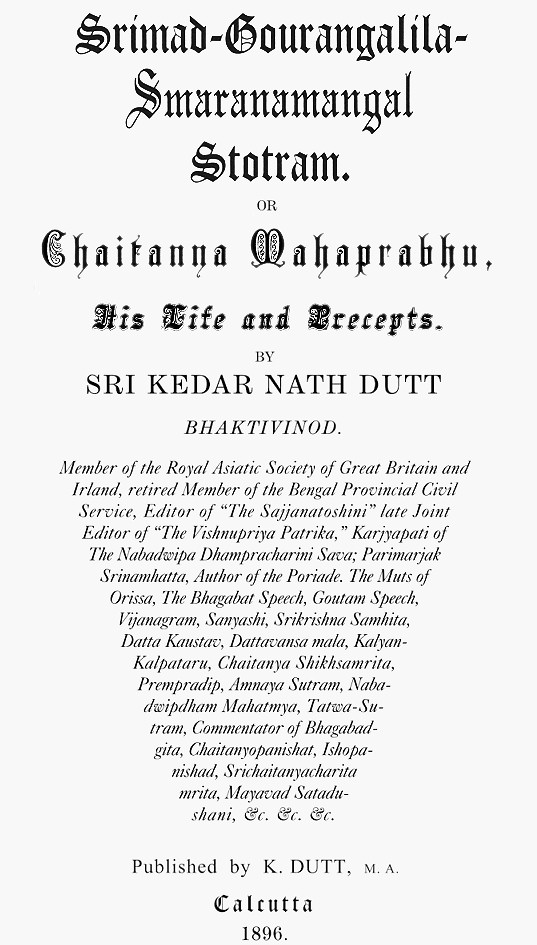
PREFACE.
In presenting this work to the public, the publisher begs to announce that the author has in a brief compass tried to explain the main features of the Vaishnava Philosophy as taught in the School of Chaitanya Mahaprabhu. Although it may appear at the outset to be very abstruse, the reader will attain a clear appreciation if he takes a little pain to study the subject carefully. The author has expressed his wishes to illucidate any portion which may appear to be inexplicit, and the publisher will always be glad to forward the author any reference directed to his address as below.
Pandit SITIKANTHA VACHASPATI whose commentaries have been published is a renowned Sanskrit scholar of Nadia.
K. P. DUTT.
I8I MANIKTALA STREET,
CALCUTTA, INDIA
20th August 1896
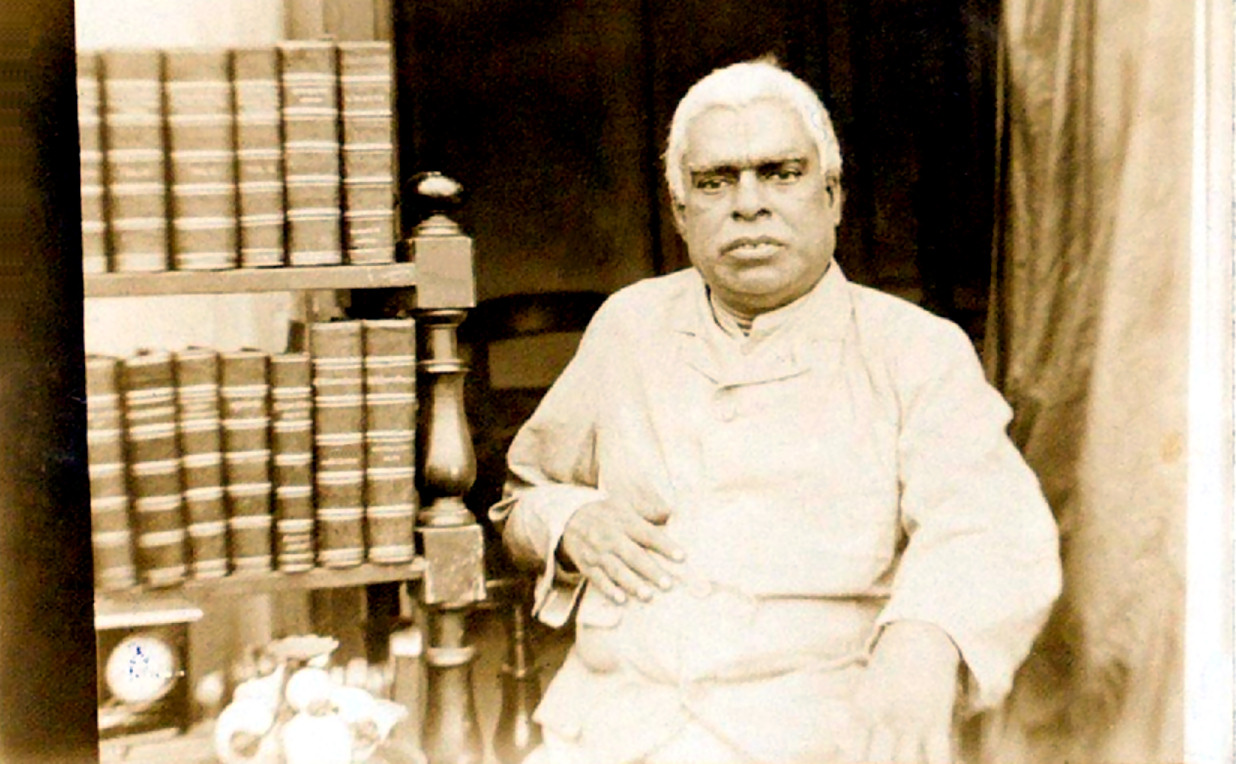
A FEW WORDS IN ENGLISH.
The object of this little book is to bring the holy life of Chaitanya Mahaprabhu and his precepts to the notice of the educated and the religious people. Most of the books treating on these subjects have hitherto been printed in Bengali character. Hence the life and precepts of Chaitanya have scarcely passed beyond the boundaries of Bengal. This book has therefore been printed in Sanskrit types for circulation all over India. Our educated brethren of Europe and America have taken, of late, to the study of the Sanskrit language, and it is our belief that this brochure will go to their hands in a very short time. This book contains 104 slokas with copious commentaries. It makes a succint mention of all the anecdotes of the life of Mahaprabhu as related in the famous book, the Chaitanya Charitamrita by Krishnadas Kaviraj. The slokas from 75 to 86 inclusive will give an outline of the precepts of that great personage. With a view to help our English-knowing readers in going through the book, we have here summarized in English the contents of the work.
 Chaitanya Mahaprabhu was born in Mayapur in the town of Nadia, just after sunset on the evening of the 23rd Falgoon 1407 Sakabda answering to the 18th February 1485 of the Christian Era. The moon was eclipsed at the time of his birth and the people of Nadia were then engaged, as usual on such occasions, in bathing in the Bhagirathi with loud cheers of Haribol. His father Jagannath Misra was a poor Brahmin of the Vaidic order and his mother Sachi Devi was a model good woman, both descended from Brahmin stocks originally residing in Sylhet. Mahaprabhu was a beautiful child and the ladies of the town came to see him with presents. His mother’s father Pandit Nilambar Chakravarti, a renowned astrologer, foretold that the child would be a great personage in time; and he, therefore, gave him the name Vishwambhar. The ladies of the neighbourhood styled him Gour Hari on account of his golden complexion and his mother called him Nimai on account of the Nim tree near which he was born. Beautiful as the lad was, every one heartily loved to see him every day. As he grew up he became a whimsical and frolicsome lad. After his fifth year, he was admitted into a pathshala where he picked up Bengali in a very short time.
Most of his contemporary biographers have mentioned certain anecdotes regarding Chaitanya which are simple records of his early miracles. It is said that when he was an infant in his mother’s arms, he wept continually and when the neighbouring ladies and his mother cried Haribol, he used to stop! Thus there was a continuation of the utterance of Haribol in the house, foreshewing the future mission of the hero. It has also been stated that when his mother once gave him sweetmeats to eat, he ate clay instead of the food. His mother asking for the reason, he stated that as every sweetmeat was nothing but clay transformed, he could eat clay as well. His mother, who was also the consort of a pandit, explained that every article in a special state was adapted to a special use. Earth, while in the state of a jug, could be used as a water pot, but in the state of a brick such a use was not possible. Clay, therefore, in the form of sweetmeats was usable as food and not clay in its other states. The lad was convinced and admitted his stupidity in eating clay and agreed to avoid the mistake in future. Another miraculous act has been related. It is said that a Brahmin on pilgrimage became a guest in his house, cooked his food and read his grace with meditation of Krishna. In the meantime the lad came and ate up the cooked rice. The Brahmin astonished at the lad’s act cooked again at the request of Jagannath Misra. The lad again ate up the cooked rice while the Brahmin was offering the rice to Krishna with meditation. The Brahmin was persuaded to cook for the third time. This time all the inmates of the house had fallen asleep and the lad shewed himself as Krishna to the traveller and blessed him. The Brahmin was then lost in ecstacy at the appearance of the object of his worship ! It has also been stated that two thieves stole away the lad from his father’s door with a view to purloin his jewels and gave him sweetmeats on the way. The lad exercised his illussory energy and deceived the thieves back towards his own house. The thieves for fear of detection, left the boy there and fled. Another miraculous act has been described of the lad’s demanding and getting from Hiranya and Jagadisha all the offerings they had collected for worshipping Krishna on the day of Ekadashi. When only four years of age he sat on rejected cooking pots which were considered unholy by his mother. He explained to his mother that there was no question of holiness and unholiness as regards earthen pots thrown away after the cooking was over. These anecdotes relate to the tender age up to the fifth year.
In his eighth year, he was admitted into the tol of Gangadas Pandit in Ganganagar close by the village of Mayapur. In two years he became well read in Sanskrit grammar and rhetoric. His readings after that were of the nature of self-study in his own house where he had found all important books belonging to his father who was a pandit himself. It appears that he read the Smriti in his own study and the Naya also jn competition with his friends who were then studying under the celebrated Pandit Raghunath Shiromani.
Now after the tenth year of his age, Chaitanya became a passable scholar in grammar, rhetoric, the Smriti and the Naya. It was after this that his elder brother Vishwarup left his house and accepted the asram ( status ) of a sanyashi ( ascetic ). Chaitanya though a very young boy consoled his parents saying that he would serve them with a view to please God. Just after that, his father left this world. His mother was exceedingly sorry and Mahaprabhu with his usually contented appearance consoled his widowed mother.
It was at the age of 14 or 15 that Mahaprabhu was married to Lakshmi Devi, the daughter of Ballabha Acharjya, also of Nadia. He was at this age considered as one of the best scholars of Nadia, the renowned seat of Naya philosophy and Sanskrit learning. Not to speak of the smarta pandits, the naiyaiks were all afraid of confronting him in literary discussions. Being a married man, he went to Eastern Bengal on the banks of the Padma for aquirement of wealth. There he displayed his learning and obtained a good sum of money. It was at this time that he preached Vaishnavism at intervals. After teaching him the principles of Vaishnavism he ordered Tapan Misra to go to and live in Benares. During his residence in East Bengal, his wife Lakshmi Devi left this world from the effects of snake bite. On returning home, he found his mother in a mourning state. He consoled her with a lecture on the uncertainty of human affairs. It was at his mother’s request that he married Vishnu Priya, the daughter of Raj pandit Sanatan Misra. His comrades joined him on his return from pravas or sojourn. He was now so renowned that he was considered to be the best pandit in Nadia. Keshab Misra of Cashmere, who had called himself the Great Digvijayi, came to Nadia with a view to discuss with the pandits of that place. Afraid of the so called conquering pandit, the tol professors of Nadia left their town on pretence of invitation. Keshab met Mahaprabhu at the Barokonaghat in Mayapur and after a very short discussion with him he got defeated by the boy and mortification obliged him to decamp. Nimai Pandit was now the most important pandit of the times.
It was at the age of 16 or 17 that he travelled to Gya with a host of his students and there took his spiritual initiation from Iswar Puri a Viashnava sanyasi and a disciple of the renowned Madhavendra Puri. Upon his return to Nadia, Nimai Pandit turned out a religious preacher and his religious nature became so strongly represented that Adwaita Prabhu, Sribasa and others, who had before the birth of Chaitanya already accepted the Vaishnava faith, were astonished at the change of the young man. He was then no more a contending naiyaika, a wrangling smarta and a criticising rhetorician. He swooned at the name of Krishna and behaved as an inspired man under the influence of his religious sentiment. It has been described by Murari Gupta, an eye witness, that he shewed his heavenly powers in the house of Sribas Pandit in the presence of hundreds of his followers who were mostly well read scholars. It was at this time that he opened a nocturnal school of kirtan in the compound of Sribas Pandit with his sincere followers. There he preached—there he sang—there he danced and there he expressed all sorts of religious feelings. Nityananda Prabhu who was then a preacher of Vaishnavism and who had then completed his travels all over India, joined him by that time. In fact a host of pandit preachers of Vaisnavism, all sincere at heart, came and joined him from different parts of Bengal. Nadia now became the regular seat of a host of Vaishnava acharjyas whose mission it was to spiritualize mankind with the highest influence of the Vaishnava creed.
The first mandate that he issued to Prabhu Nityananda and Haridas was this “Go friends, go through the streets of the town, meet every man at his door and ask him to sing the name of Hari with a holy life, and you then come and report to me every evening the result of your preaching.” Thus ordered, the two preachers went on and met Jagai and Madhai the two most abominable characters. They insulted the preachers on hearing Mahaprabhu’s mandate, but were soon converted by the influence of bhakti inculcated by their Lord. The people of Nadia were now surprised. They said, “Nimai Pandit is not only a gigantic genius but he is certainly a missionary from God Almighty.” From this time to his 23rd year Mahaprabhu preached his principles not only in Nadia but in all important towns and villages around his city. In the houses of his followers he shewed miracles, taught the esoteric principles of bhakti and sang his sankirtan with other bhaktas. His followers of the town of Nadia commenced to sing the holy name of Hari in the streets and Bazars. This created a sensation and roused different feelings in different quarters. The bhaktas were highly pleased. The smarta Brahmins became jealous of Nimai Pandit’s success and complained to Chand Kazi against the character of Chaitanya as un-Hindu. The kazi came to Sribas Pandit’s house and broke a mridanga (khol) there and declared that unless Nimai Pandit would cease to make noise about his queer religion he should be obliged to enforce Mahamadanism on him and his followers. This was brought to Mahaprabhu’s notice. He ordered the town people to appear in the evening, each with a torch in his hand. This they did and Nimai marched out with his sankirtan divided in 14 groups and on his arrival in kazi’s house, he held a long conversation with the kazi and in the end communicated into his heart his Vaishnav influence by touching his body. The kazi then wept and admitted that he had felt a keen spiritual influence which had cleared up his doubts and produced in him a religious sentiment which gave him the highest ecstacy. The kazi then joined the sankirtan party. The world was astonished at the spiritual power of the Great Lord and hundreds and hundreds of heretics converted joined the banner of Vishwambhar after this affair.
It was after this that some of the jealous and low minded Brahmins of Kulia picked up a quarrel with Mahaprabhu and collected a party to oppose him. Nimai Pandit was naturally a soft hearted person, though strong in his principles. He declared that party feeling and sectarianism were the two great enemies of progress and as long as he should continue to be an inhabitant of Nadia belonging to a certain family, his mission would not meet with complete success. He then resolved to be a citizen of the world by cutting of his connexion with a particular family, caste and creed and with this resolution he embraced the position of a sanyasi at Cutwa under the guidance of Keshab Bharati of that town, on the 24th year of his age. His mother and wife wept bitterly for his separation but our hero though soft in heart was a strong person in principle. He left his little world in his house for the unlimited spiritual world of
Krishna with man in general.
After his sanyas, he was induced to visit the house of Advaita prahbu in Santipur. Advaita managed to invite all his friends and admirers from Nadia and brought Sachidevi to see her son. Both pleasure and pain invaded her heart when she saw her son in the attire of a sanyasi. As a sanyasi Krihsna Chaitanya put up nothing but a kaupin and a bahirbas ( outer covering ). His head was without hairs and his hands bore a danda ( stick ) and a kamandalu ( hermit’s water pot ). The holy son fell at the feet of his beloved mother and said, “Mother ! this body is yours and I must obey your orders. Permit me to go to Vrindaban for my spritual attainments.” The mother in consultation with Advaita and others asked her son to reside in Puri (town) of Jagannath so that she might obtain his information now and then. Mahaprabhu agreed to that proposition and in a few days left Santipur for Orrissa. His biographers have described the journey of Krishna Chaitanya ( that was the name he got after his sanyas ) from Santipur to Puri in great details. He travelled along the side of the Bhagirathi as far as Chhatra- bhoga situated now in Thana Mathurapur Diamond Harbour, 24 Perghs. There he took a boat and went as far as Prayag ghat in the Midnapur District. Thence he walked through Balasore and Cuttack to Puri, seeing the temple of Bhubaneshwar on his way. Upon his arrival at Puri, he saw Jagannath in the temple and put up with Sarvabhouma at the request of the latter. Sarvabhouma was a gigantic pandit of the day. His readings knew no bounds. He was the best Naiyaik of the times and was known as the most erudite scholar in the Vedant Philosophy of the school of Sankaracharya. He was born in Nadia ( Vidyanagar ) and taught innumerable pupils in the Naya Philosophy in his tol there. He had left for Puri sometimes before the birth of Nimai Pandit. His brother-in-law Gopinath Misra introduced our new sanyasi to Sarvabhouma, who was astonished at his personal beauty and feared that it would be difficult for the young man to maintain sanyas-dharma during the long run of his life. Gopinath, who had known Mahaprabhu from Nadia, had a great reverence for him and gave out that the sanyasi was not a common human being. On this point Gopinath and Sarvabhouma had a hot discussion. Sarvabhouma then requested Mahaprabhu to hear his recitation of the Vedunt sutras to which the latter tacitly submitted. Chaitanya heard with silence what the great Sarvabhouma uttered with gravity, for seven days, at the end of which the latter said “Krishna Chaitanya ! I think you do not understand the Vedant as you do not say anything after hearing my recitations and explanations.” The reply of Chaitanya was that he understood the sutras very well, but he could not make out what Sankaracharya meant by his commentaries. Astonished at this, Sarvabhouma said “How is it that you understand the meanings of the sutras and do not understand the commentaries which explain the sutras ? All well ! If you understand the sutras, please let me have your interpretations?” Mahaprabhu thereon explained all the sutras in his own way without touching the Pantheistic commentary of Sankar. The keen understanding of Sarvabhouma saw the truth, beauty and harmony of arguments in the explanations given by Chaitanya and obliged him to utter that it was the first time that he found one, who could explain the Brahma sutras in such a simple manner. He admitted also that the commentaries of Sankar never gave such natural explanations of the Vedant sutras as he had obtained from Mahaprabhu. He then submitted himself as an advocate and follower. In a few days Sarvabhouma turned out as one of the best Vaishnavs of the times. Report ran out,—whole of Orrissa sang the praise of Krishna Chaitanya and hundreds and hundreds came to him and became his followers. In the meantime Mahaprabhu thought of visiting Southern India, and he started With one Krishnadas Brahmin for the journey.
His biographers have given us a detail of the journey. He first went to Kurmakshetra where he did a miracle by curing a leper named Vasudev. He met Ramananda Rai, the governor of Vidyanagar on the banks of the Godavari and had a philosophical conversation with him on the subject of Prembhakti. He worked another miracle by touching (making them immediately disappear) the seven Tal trees, through which Ramchandra, the son of Dasarath had shot his arrow and killed the great Bali Raj ! He preached Vaishnavism and nam-sankirtan throughout his journey. At Rangakshetra he staid for four months in the house of one Venkat Bhatta in order to spend the rainy season. There he converted the whole family of Venkat from Ramanuji Vaisnavism into Krishna bhakti, along with the son of Venkat, a boy of ten years, named Gopal, who afterwards came to Vrinda- van and became one of the six Gosvamis or Prophets serving under their leader Srikrishna Chaitanya. Trained up in Sanskrit by his uncle Probodhananda Sarasvati, Gopal wrote several books on Vaishnavism.
Chaitanya visited numerous places in southern India as far as Cape Comorin and returned to Puri in two years by Panderpur on the Bhima. In this latter place he spiritualized one Tukaram who became from that time a religious preacher himself. This fact has been admitted in his abhangas which have been collected in a volume by Mr. Satyendranath Tagore of the Bombay Civil Service. During his journey he had discussions with the Budhists, the Jains and the mayavadis in several places and converted his opponents to Vaishnavism.
Upon his return to Puri, Raja Prataprudra Dev and several pandit Brahmins joined the banners of Chaitanya Mahaprabhu. He was now twenty-seven years of age. In his 28th year he went to Bengal as far as Gour in Maldah. There he picked up two great personages named Rup and Sanatan. Though descended from the line of the Karnatic Brahmins, these two brothers turned out demi-musalmans by their continual contact with Hossain Shah, the then Emperor of Gour. Their names had been changed by the Emperor into Dabirkhash and Saker Mallik and their master loved them heartily as they were both learned in Persian, Arabic and Sanskrit and were loyal servants of the state. The two gentlemen had found no way to come back as regular Hindus and had written to Mahaprabhu, while he was at Puri, for spiritual help. Mahaprabhu had written in reply that he would come to them and extricate them out of their spiritual difficulties. Now that he had come to Gour, both the brothers appeared before him with their long standing prayer. Mahaprabhu ordered them to go to Vrindavan and meet him there.
Chaitanya returnd to Puri through Santipur where he again met his dear mother. After a short stay at Puri he left for Vrindavan. This time he was accompanied by one Balabhadra Bhattacharya. He visited Vrindavan and came down to Prayag ( Allahabad ) converting a large number of Mahomedans into Vaishnavism by arguments from the Koran. The descendants of those converts are still known as Pathan Vaishnavs. Rup Gosvami met him at Allahabad. Chaitanya trained him up in spirituality in ten days and directed him to go to Vrindavan on two missions. His first mission was to write theological works explaining scientifically pure bhakti and prem. The second mission was to revive the places where Krishnachandra had in the end of Dwapar yug exhibited His spiritual lila for the benefit of the religious world. Rup Gosvami left Allahabad for Vrindavan and Mahaprabhu came down to Benares. There he put up in the house of Chandrasekhar and accepted his daily bhiksha (meal) in the house of Tapan Misra. Here it was that Sanatan Gosvami joined him and took instructions for two months in spiritual matters. The biographers, specially Krishnadas Kaviraj, have given us details of Chaitanya’s teachings to Rup and Sanatan. Krishnadas was not a contemporary writer, but then he gathered his informations from the Gosvamis themselves, the direct disciples of Mahaprabhu. Jiv Gosvami, who was nephew of Sanatan and Rup and who has left us his invaluable work the Sath-sandarbha, has philosophized on the precepts of his great leader. We have gathered and summarized the precepts of Chaitanya from the books of those great writers.
While at Benares, Chaitanya had an interview with the learned sanyasis of that town in the house of a Marhatta Bramhin who had invited all the sanyasis for an entertainment. At this interview, Chaitanya shewed a miracle which attracted all the sanyasis to him. Then ensued reciprocal conversations. The sanyasis were headed by their most learned leader Prakashananda Sarasvati. After a short controversy they submitted to Mahaprabhu and admitted that they had been misled by the commentaries of Sankaracharya. It was impossible even for learned scholars to oppose Chaitanya for a long time, as there was some spell in him which touched their hearts and made them weep for their spiritual improvement. The sanyasis of Benares soon fell at the feet of Chaitanya and asked for his grace ( kripa ) Chaitanya then preached pure bhakti and instilled into their hearts a spiritual love for Krishna which obliged them to give up sectarian feelings. The whole of Benares, on this wonderful conversion of the sanyasis, turned out Vaishnavas and they made a monster sankirtan with their new Lord. After sending Sanatan to Vrindavan, Mahaprabhu went to Puri again by the jungles with his comrade Balabhadra. Balabhadra has reported that Mahaprabhu shewed a good many miracles on his way to Puri such as making tigers and elephants dance, on hearing the name of Krishna.
From this time, that is from his 31st year, Mahaprabhu continually lived in Puri in the house of Kasi Misra until his disappearance in his forty-eigth year at the time of sankirtan in the temple of Tota Gopinath. During these 18 years, his life was one of settled love and piety. He was surrounded by numerous followers, all of whom were of the highest order of the Vaishnavas, and distinguished from the common people by their purest character and learning, firm religious principles and spiritual love in Radhakrishna. Svarupdamodar, who had been known by the name of Purushottamacharya while Mahaprabhu was in Nadia, joined him from Benares and accepted his service as his secretary. No production of any poet or philosopher could be laid before Mahaprabhu unless Svarup had passed it as pure and useful. Rai Ramananda was his second mate. Both he and Svarup sang while Mahaprabhu expressed his sentiment on a certain point of worship. Paramananda Puri was his minister in matters of religion. There are hundreds of anecdotes described by his biographers which we do not think it meet here to reproduce. Mahaprabhu slept short. His sentiments carried him far and far in the firmament of spirituality every day and night and all his admirers and followers watched him throughout. He worshiped, communicated with his missionaries at Vrindavan, and conversed with those religious men who newly came to visit him. He sang and danced, took no care of himself and oft times lost himself in religious beatitude. All who came to him, believed him as the all-beautiful God appearing in the nether world for the benifit of mankind. He loved his mother all along and sent her mahaprasad now and then with those who went to Nadia. He was most amiable in nature. Humility was personified in him. His sweet appearance gave cheers to all, who came in contact with him. He appointed Prabhu Nityananda as the missionary in charge of Bengal. He despatched six disciples (Gosains) to Vrindaban to preach love in the up-country. He punished all of his disciples who deviated from a holy life. This he markedly did in the case of junior Haridas. He never lacked in giving proper instructions in life to those who solicited them. This will be seen in his teachings to Raghunath Das Gosvami. His treatment to Haridas (senior) will show how he loved spiritual men and how he defied caste distinction in case of spiritual brotherhood.
We now proceed to explain his precepts to those who are not acquainted with them. This little book and the commentaries contain such of his holy principles as are prominent.
Chaitanya teaches us in the first place that the rational attributes of men are not capable of approaching the Divine sphere of spirit. Jukti as he styles reason, is quite incompetent in such a matter. Ruchi as he styles the religious sentiment in man, even in a very small quantity, has the power to comprehend it. It is inspiration which can alone give light to spiritual matters. Inspirations coming down from Heaven through purified and blessed souls have exhibited themselves in the form of the Vedas. The Vedas, together with their explanatory notes, the Puranas, are therefore the only evidence in matters of spirit and are eternal in nature. Vedic truths should, therefore, be accepted as the only truth in higher matter. Reason, while sincerely helping the inspired truth, may be acceptad as auxiliary evidence. The Vedas teach us according to Chaitanya, nine principal doctrines, that is;—
(1) Hari (the Almighty) is one without a second.
(2) He is always vested with infinite power.
(3) He is ocean of Rasa.
(4) The soul is His Vibhinnangsha or separated part.
(5) Certain souls are engrossed by Prakriti or His illusory energy.
(6) Certain souls are released from the grasp of Prakriti.
(7) All spiritual and material phenomena are Bhedabhed-prakasha of Hari the Almighty.
(8) Bhakti is the only means of attaining the final object of spiritual existence.
(9) Prem in Krishna is alone the final object of spiritual existence.
We must explain these points one by one:—
1° Hari the Supreme Being is one without a second. In Aryan theology the creative principle of the Deity is personified in Brahma and the destructive principle in Shiva. Indra is the head of some lower elements of adminstration. Hence they are not the Almighty Himself but are differnt representations of different attributes. They have obtained their powers from an original Fountainhead. Hence they are subordinate beings in the service of Hari or Bhagavan. Then again there are three distinct philosophical ideas of the Deity i.e. (i) the idea of the negative Brahma of the Pantheistic school, (ii) the idea of an universal soul, Paramatma of the yoga school and (iii) the idea of a personal Deity with all His majesty, might, glory, beauty, wisdom and supremacy combined in the person. The ideas of Bramha and Paramatma are therefore included in the idea of Bhagavan. Spiritually, therefore, Bhagavan is Hari the Supreme Being. Human ideas are either mental or spiritual. The mental idea is defective as it has relation to the created principle of matter. The spiritual idea is certainly the nearest approach to the Supreme Being. Then again the spiritual idea of Bhagavan is of two sorts. In one sort, the person of the Deity is overpowered by His own majesty, and in the other, the personal beauty overpowers all His majesty. The first idea is represented in the great Narayan of Vaikuntha, who is the Lord of Lords and God of Gods. The second is represented in the All-beautiful Krishna with Radhika, the representative of His Hladini or superior ecstatic energy. Krishna appears as man amongst men and is again generally accepted as God above Gods. Krishna attracts, loves, and produces ecstacy in all souls. His person and personal attachments are all purely spiritual and have no relation to the material world. The material senses of man can not approach Him. It is the spirit in man which can see Him direct and commune with Him. The soul fettered in matter, has from its own degradation lost its right to see Krishna and his spiritual lila in the spiritual world, but Krishna out of His own Supreme Power and prerogative may appear with all His Vrindavan lila before the eyes of all men. The rational man can hardly conceive and believe Krishna and His lila. As his spiritual essence improves, he sees Him and loves Him with all his heart. In our small compass, we can hardly treat this subject fully and exhaustively. We, therefore, leave this point to our readers with these words. “Give up the shackles of matter slowly. Cultivate your spirit inwards. Give up prejudices which you have acquired from the so-called rational thinkers who deny the existence of spirit. Be humble in yourself and learn to respect those who work towards spiritual attainments. Do these with your heart, mind and strength in the company of spiritual people alone, and you will see Krishna in no time.” Krishna is not an imaginary Being, nor you have a right to think that He is a material phenomenon fancied to be the Supreme Being by the fools. Krishna is not understood by the process of distinguishing the subjective from the objective, nor He is to be accepted as an imposition on the people set up by designing men. Krishna is eternal, spiritually true, reflected on the human soul when relieved of all pressure of gross matter and is the subject of love which proceeds from the soul. Accept Him as such and you will see Him in your soul’s eye. Words fail to describe that transcendental Being. The highest, best and most spiritual ideal of the Divinity is in Krishna. To bring arguments against Him is simply to deceive one’s self and deprive himself of the blessings that God has kept in store for man. Hence all descriptions of His name, person, attributes and lila should be accepted spiritually, giving up the material portion which words must necessarily convey.
2° Hari is always vested with infinite powers. By infinite powers must be meant powers which know no bounds either in space or in time; as His powers alone created space and time. His powers are identified with His person. In material objects, there is a difference between the person and its powers, between the thing and its attributes, its name, its form and action; but it is a spiritual truth that in spirit the thing is identical with its name, form, attributes and action. This truth can not be subjected to dry reason which deals with gross matter alone. Krishna is Supreme Will in Himself and He exercises His supreme power at His pleasure, which submits to no law, because all law has proceeded from His Will and Power. Power is known from its exercise. In this world we have experience of only three of the attributes of His power. We see the material phenomena and we understand that His power has the attribute to create matter. This attribute is styled in the Vedas as Maya-shakti. We see man and we understand that the Supreme power has the attribute to produce limited and imperfect souls. The sastras call that attribute as Jiva-shakti. We conceive of One who is spiritual and supreme in his realm of eternal spirits. We understand that His power has an attribute to exhibit perfectly spiritual existences. The Vedas call that attribute by the name of Atma-shakti or Chit- shakti. All these attributes together form one supreme power which the Vedas call as Para-shakti. In fact power (shakti) is not distinguishable from the person of that Being. Still the powers are separately exhibited in their separate actions. This is styled Achintya-bhedabhed prokash or inconceivable simultaneous existence of distinction and non-distinction. Hari being Will above law, exercises His infinite powers, while He Himself remains unaffected. This is not understood, but felt in the soul as an intuitive truth.
3°. He is the ocean of rasa. Rasa has been defined to be that ecstatic principle which comprehends sthayi bhab, bibhab, anubhab, satvik and sanchari. Bibhab is divided into Alambana and Uddipana. Alambana is subdivided into Vishaya and Asraya. Asraya is that person who has in himself the principle of sthayi-bhab and vishaya is that person to whom the sthayi-bhab directs itself. Sthayi-bhab has been explained to be rati or tendency of the pure spiritual heart. By a connection of Asraya and Vishaya the sthayi-bhab arrives at its stage of action. When it obtains its active stage, certain signs are exhibited in the person which are called the Anubhabs. These are thirteen in number (vide Sanskrit commentary to 79th sloka). Eight other bhabs exhibiting on the mind are styled satvik-bhab such as tears, shivering, etc. Thirty three other bhabs such as harsha, vishad, etc. have been shewn to be sanchari-bhabs. These combined in soul form the rasa. This process of exhibition of rasa relates to exhibition of Rasa in man still enthralled in matter. But Rasa itself is an eternal principle identified with the Supreme Hari. Hari is the ocean of Rasa and in the human soul a drop of the ocean could only be conceived. Rasa naturally is spiritual but in man subjected to Maya the progenitor of matter, it has been identified, in a perverted state, with the sensual pleasure of man in connection with material objects, the soul losing itself in mind and the mind acting through the senses enjoying the perverted Rasa in five different objects of the five senses. This is the soul’s going abroad with avidya or ignorance of the spiritual self. When the soul looks inward, it obtains its spiritual Rasa and the perverted Rasa wanes off in proportion to the development of the spiritual Rasa. In spiritual Rasa the souls towards each other and all towards the All-beautiful, have their unfettered action in Vrindavan, rising above material time and space. Hari or Infinite Supreme Free Will has eternal ecstacy in His spiritual power or chit-shakti. The Hladini attribute of chit-shakti gives Him infinite pleasure. The sambit attribute of ‘chit-shakti’ ( spiritual wisdom ) produces all bhabs, relations and affections. The sandhini attribute of ‘chit-shakti’ produces all existence (other than the free will) including the dhams (abodes), individualities and other substances in connection with the action of the spiritual Rasa. All these exhibitions are from ‘chit-shakti’ or the spiritual power. The Mayik or material creation including time, space and gross objects, has no place in chit-jagat or the spiritual world which is all the same as Vrindavan. ‘Maya-shakti’ is a perverted reflection of the ‘chit-shakti’. Hence the particularities in the ‘Mayik’ (material) world have semblance with the particularities in the ‘chit-jagat’ or (spiritual universe), but are not substantially the same. The ‘chit-jagat’ is the model of the ‘Mayik-jagat’ but they are not identical. We must guard ourselves against the idea, that man has imagined ‘chit- jagat’ from an experience of the ‘Mayik-jagat’. This idea is pantheistic and it may also be styled atheistic. Reason, not spiritualized, has a tendency to create such a doubt, but one who has a wish to enjoy spiritual love must give it up as misleading. The eternal Rasa of Krishna exists spiritually in ‘chit-jagat”. To us who are in the nether world there is a screen which intervenes between our eyes and the great spiritual scene of Krishnalila. When by the grace of Krishna that screen is drawn up, we have the privilege to see it, and again when it pleases the Almighty to drop the screen the great Vrindavan lila disappears. Taste the subject and your conviction will be the same as mine. Brethren! do not give up such an important subject without due and liberal examination.
4° The soul is His Vibinangsha or separated part. By soul are meant all sorts of souls whether animal, human or celestial. It must be understood that Mahaprabhu believed in the very liberal theory of transmigration of the soul. Certain readers may reject the idea on the ground that certain forms of faith do not support that theory. It is not liberal to reject a theory because it is in antagonism with the dogmas of certain sectarian creeds. Indeed it is a matter which reason can not dare to meddle with. Candidly examining, we do not see any strong reason to disbelieve the theory of transmigration. On the other hand, our unprejudiced mind is inclined to stand for it. The belief that the human soul has only one trial in life is evidently illiberal, unjust and contrary to the belief that God is all good. When our spiritual sentiment supports the theory and the Vedas, the receptacles of inspirations, have taught us the fact of continual existence of the soul in different stages in creation, we can not but give up the idea of disbelieving in the theory of transmigration of the soul. However educated and scientific a man may be, he is always liable to a creeping error. That which holds good regarding a man holds good also regarding a nation or a sect.
The soul, according to Chaitanya, is an atomic part of the Divine soul. It is a sort of God’s power to produce beings who are spiritual in essence but liable to be enthralled by ‘Maya’ when they forget their position as eternal servants of the Deity. God here is compared with the sun and the souls are said to be the atomic portions of that sun’s ray, unable to stand freely unless they are protected by another competent attribute of God’s power. By the word part is not meant to be portions cut out of a piece of stone by the axe, but is meant to be like one lamp lighted from another, or gold produced from an alchemic stone as believed by the ancients. The souls are also compared with separate atomic emanations of the burning fire. Each soul has drawn from its fountain-head a proportionate share of the attributes and consequently a small proportion of the free will. These souls are naturally located between the ‘chit- jagat’ and ‘Mayik-jagat.’ Those who chose to serve their God were protected from fall by the interference of the hladini attribute of the supreme ‘chit-shakti’, They have been admitted as etenral servant of the Deity in various ways. They know not the troubles of maya and her Karma-Chakra or the rotative principle of Mayic action and its result. Those who wanted to enjoy were grasped by Maya from the other side. They are in Maya’s Karma-Chakra ending only when they again see their original position as servants of the Deity. These souls whether liberatad from Maya or enthralled by her are separate responsible beings depending on the Deity. Hari is the Lord of Maya who serves Him at His pleasure. The soul or Jiva is so constructed as to be liable to be enthralled by Maya in consequence of want of power when unassisted by the Hladini Shakti of the Deity. Hence there is a natural and inherent distinction between God and Jiva which no pantheistic manouvre can annihilate. Please avoid the misleading question “ when were these Jivas created and enthralled? The Mayic time has no existence in spiritual history because it has its commencement after the enthralment of Jivas in matter and you can not therefore employ Mayik chronology in matters like these.
5° Certain souls are engrossed by Prakriti or illusory energy. Prakriti, God’s Maya, Pradhan, Prapancha and Avidya are different names of the same principle on account of its different phases and attributes. Maya is not an independent Shakti from the supreme Svarup Shakti. She is simply a reflected and outward phase of the supreme Power serving God in executing His penal orders on those who become ungrateful to Him. In fact Maya is in charge of God’s house of correction. Those Jivas who in abusing their free will, forgot that they were eternal servants of the Deity and thought of enjoying for themselves were grasped by Maya for their penal servitude and correction. Maya has three attributes Satwa, Raja and Tama. Those attributes are just like chains used to tie up the ungrateful souls. Maya then applied a double case on the spiritual form of the soul. The double case is described by the words linga and sthhul. The Mayik existence has twenty four substances; the five elements:— the earth, the water, the fire, the air, and the firmament; the five properties :— the sound, the touch, the sight, the taste and the smell and ten Indrias i e the five senses; the eye, the ear, the nose, the tongue and the touch and five working organs such as hands, legs &c. These twenty form the sthhul or outer case. The mana, the buddhi, the chitta and the ahankar i e the mind, the understanding, the attention and the perverted ego, compose the linga deha or the inner case. Then after encasing the spiritual form of the soul, Maya employs the fallen souls to work. Mayik work is composed of Karma, Akarma and Vikarma. Karma is conventionally good action done to obtain punya or virtue such as performance of duties enjoined by the Varnasram-dharma of the smartas. Akarma is ommission to do duty. Vikarma is sin or crime. Karma procures heavenly elevations up to the Brahmalok. Akarma gives an unpleasant state on earth. Vikarma hurls down souls to hell. The fallen souls travel from body to body with their linga deha doing Karma or Vikarma, rising up to the heavens and again coming down at the exhaustion of their virtues, going down to hell and, after suffering punishment, again rising up to the platform of work. Thus the state of the fallen souls is deplorable in the extreme. There they enjoy and suffer, massacre and murder, and go on in this state, some times smiling as princes and some times ruing as sufferers. The world is therefore a prison or a house of correction and not a place for enjoyment as some people assert.
6° Certain souls are released from the grasp of Prakriti. Jivas are travelling in the path of mayik existence from time out of mind experiencing all sorts of pleasure and pain. How to get rid of this unpleasant state of existence ? No, dharma, performance of duty, yog, devolopement of powers of the sthhul and the linga, Sankhya, or the division of substances under their categories and simple knowledge that one is a spiritual being, and Vairagya ( abnegation ) giving up all enjoyments in the world, are not the proper means by which one can actually get what he wants. When a man comes in contact with a Vaishnav, whose heart has been melted by Hari-bhakti rasa, it is then that he loves to imbibe the sweet principle of Bhakti by following his holy foot steps, by constant study of Krishna bhakti. He slowly washes off his mayik condition and in the end obtaining his true nature he enjoys the sweetest unalloyed rasa which is the ultimatum of the soul. Satsanga or the company of the spiritual people is the only means to obtain the ultimate object of man. Bhakti is a principle which comes from soul to soul and, like electricity or magnetism in gross matter, it conducts itself from one congenial soul to another. The principle of Bhakti is sincere and entire dependence on the Deity in every act of life. The principle of duty is no part of Bhakti as it acts as gratitude for favor obtained and it works like an obligation which is contrary to natural love. The principle of morality in the mortal world, though good in its own way, does scarcely give spiritual consequence in the end. Faith in the supreme beauty of the Deity, a desire for the eternal unselfish service of that Being and a consequent repulsion of every other thought of pleasure or self-aggrandizement are the three principles which constitute shradha or actual hankering after Bhakti. Bhakti by nature is ananya or exclusive. Is it chance then which brings Bhakti ? No, Sukriti or good work is the prime moving principle. Good work is of two classes. One class, passing as morals, includes those works which bring virtue and aggrandizement. The other class of good work includes all acts which have a tendency to bring spiritual culture. This latter class of good work or sukriti brings one in contact with a sincere Vaishnav from whom the man at first imbibes sraddha or faith in spirit and being then capable of receiving Bhakti obtains a flash of that principle from the Vaishnav who is the actual Guru of the man.
7° All spiritual and material phenomena are Achintya Bhedabhed prakash of Hari the Almighty. Metaphysical discussions are perfectly useless. The Vedas go some times to establish that Jiva is distinct from the Deity, and some times that Jiva is the same as the Deity. In fact the Vedas always tell the truth. Jiva is simultaneously distinct from and identical with God. This is not understood by the rationalist. Hence it must be said that in exercise of his powers beyond human comprehension, God is distinct from Jiva and the world, and again identical with them at all times. The Vedanta teaches us the Sakti-parinamvad and not the erroneous Vivartavad of San-karacharya. Sankar’s teachings are explained in different ways. Some say that the world and Jiva have emanated from God and others establish that Jiva and the world are but developments of the God-head. Sankar in order to avoid Brahmaparinam i e transformation of the Godhead into the world establishes that Vyas teaches us Vivartavad which is this, that God undergoes no change whatever, but it is Maya which covers a part of the Deity, (Just as a pot encloses a part of the firmament) creates the world; or that God is reflected on avidya or ignorance, while in fact nothing else than God has yet come to existence. These are worthless and abstruse arguments. It is plain that the Vedant teaches us that God is unchangable and is never subject to modifications. His power alone creates Jiva and the material world by its own parinam (modification). The example is in the action of the Alchemist’s stone the power of which comes in the form of gold while the stone remains unchanged. Thus Chit shakti goes in the form of the chit-jagat with all its particularities of eternal rasa and Jiv-shakli goes in the form of innumerable Jivas, some staying in Vaikuntha as parshadas or angels and others moving in this world in various shapes and forms and under very different circumstances. Maya shakti creates numerous worlds for the habitations and entertainments of the fallen souls. Vivartavad is no doubt an error and is quite opposed to the teachings of the Vedas. Now ‘Sakti parinam vad’ alone is true and supports the facts that spiritual love is eternal. If Vivartavad were true the natural consequence would be to declare spiritual love to be a temporary principle.
8° Bhakti is the only means of attaining the final object of spiritual existence. Karma as it is, can not directly and immediately produce spiritual result. When it does, it does by means of Bhakti. Hence Bhakti is independent and Karma and Gyan are dependent principles. Gyan or the knowledge, that man is a spiritual being, can not directly bring the ultimate object. When it does, it does with the assistance of Bhakti. Bhakti, therefore, is the only means to obtain the ultimatum. Bhakti is thus defined. Bhakti is cultivation of a friendly sentiment for Krishna, free from all desires other than those for its own improvements, unalloyed by such other ingredients as Karma and Gyan &c. It will be seen that Bhakti is itself both a feeling and an action. Bhakti has three stages viz sadhan bhakti, bhab bhakti, and prem-bhakti. Sadhan bhakti is that stage of culture when the feeling has not yet been roused. In Bhab bhakti the feeling awakes, and in Prem bhakti the feeling is fully set to action. Bhakti is a spiritual feeling towards the spiritual object of love. Sadhan bhakti is of two sorts, one is called the Vaidha sadhan -bhakti and the other is Raganuga sadhan-bhakti. The word Vaidha is from Vidhi or rule. Where Bhakti is to be roused by the rule of the Shastras, there the ‘Vaidhi bhakti’ works as long as the feeling is not roused. Where one out of natural tendency loves Krishna, there is a principle called Rag, which is no other than a strong desire to serve the Lord of the heart. One who is tempted by the beauty of this process to follow him, has a tendency to cultivate his feeling for Krishna. This is ‘Raganuga sadhan bhakti’. This latter class of Sadhan is stronger than the ‘Vaidhi sadhan’. Cultivation of the friendly feeling for Krishna is performed in nine different forms.
1° To hear of the spiritual name, form, attribute and lila of Krishna.
2° To utter and sing all those.
3° To meditate on and reiterate all those.
4° Service of His Holy feet.
5° Worship.
6° Bowing down.
7° Doing all that pleases Him.
8° Friendship.
9° Resignation.
Of all these forms Kirtan or singing the name &c of Krishna is the best. Humble knowledge is necessary in these forms of worship and fruitless discussions must be avoided. There are some who start at the theory of worshipping Srimurti ! Oh they say “It is idolatory to worship ‘Srimurti’ ! Srimurti is an idol framed by an artist and introduced by no other than Beelzebub himself. Worshipping such an object would rouse the jealousy of God and limit His omnipotence, omniscience and omnipresence ! We would tell them, Brethren ! candidly understand the question and do not allow yourself to be misled by sectarian dogmas. God is not jealous, as he is without a second. Beelzebub or Satan is no other than an object of imagination or the subject of an allegory. An allegorical or imaginary being should not be allowed to act as an obstacle to Bhakti. Those who believe God to be impersonal, simply identify Him with some power or attribute in nature, though in fact He is above nature, her laws and rules. His Holy wish is law and it would be sacrelege to confine His unlimited excellence by identifying Him with such attributes as omnipotence omnipresence, and omniscience,— attributes which may exist in created objects such as time, space &c. His excellence consists in having in Him mutually contradicting powers and attributes ruled by His Supernatural self. He is identical with His All-beautiful person, having such powers as omnipresence, omniscience and omnipotence, the like of which can not be found elsewhere. His Holy and perfect person exists eternally in the spiritual world and at the same time existing in every created object and place in all its fulness. This idea excels all other ideas of the Deity. Mahaprabhu rejects idolatory as well, but considers Srimurti worship to be the only unexceptionable means of spiritual culture. It has been shewn that God is personal and All-beautiful. Sages like Vyas and others have seen that beauty in their soul’s eye. They have left us descriptions. Of course word carries grossness of matter. But truth still is perceivable in those descriptions. According to those descriptions one delineates a Srimurti and sees the great God of our heart there with intense pleasure ! Brethren ! is that wrong or sinful ? Those who say that God has no form either material or spiritual and again imagine a false form for worship are certainly idolatrous. But those who see the spiritual form of the Deity in their soul’s eye, carry that impression as far as possible to the mind and then frame an emblem for the satisfaction of the material eye for continual study of the higher feeling are by no means idolatrous. While seeing a ‘Srimurti’ do not even see the image itself but see the spiritual model of the image and you are a pure theist. Idolatory and ‘Srimurti’ worship are two different things; but my brethren ! you simply confound one with the other out of hastiness. To tell you the truth, Srimurti worship is the only true worship of the Deity, without which you can not sufficiently cultivate your religious feelings. The world attracts you through your senses and as long as you do not see God in the objects of your senses, you live in an awkward position which scarcely helps you in procuring you your spiritual elevation. Place a Srimurti in your house. Think that God Almighty is the guardian of the house. The food that you take is His Prasad. The flower and scents are also His Prasad. The eye, the ear, the nose, the touch and the tongue all have a spiritual culture. You do it with a holy heart and God will know it and judge you by your sincerity. Satan and Beelzebub will have nothing to do with you in that matter ! All sorts of worship are based on the principle of Srimurti. Look into the history of religion and you will come to this noble truth. The Semetic idea of a patriarchal God both in the pre-christian period of Judaism and post-christian period of Christanity and Mahamadanism is nothing but a limited idea of Srimurti. The monarchic idea of a Jove amongst the Greeks and of an Indra amongst the Arian Karma-kandis is also a distant view of the same principle. The idea of a force and Jotirmaya Brahma of the meditators and a formless energy of the Shaktas is also a very faint view of the Srimurti. In fact the principle of Srimurti is the truth itself differently exhibited in different people according to their different phases of thought. Even Jaimini and Comte who are not prepared to accept a creating God, have prescribed certain phases of the Srimurti, simply because they have been impelled by some inward action from the soul ! Then again we meet with people who have adopted the Cross, the Shalgram shila, the lingam and suchlike emblems as indicators of the inward idea of Srimurti. Furthermore, if the Divine compassion, love and justice could be portrayed by the pencil and expressed by the chisel why should not the personal beauty of the Deity embracing all other attributes be portrayed in poetry or in picture or expressed by the chisel for the benefit of man ? If words could impress thoughts, the watch could indicate time and sign could tell us a history, why should not the picture or figure bring associations of higher thoughts and feelings with regard to the transcendental beauty of the Divine Personage?
Srimurti worshipers are divided into two classes, the ideal and the physical. Those of the physical school are entitled from their circumstances of life and state of the mind to establish temple institutions. Those who are by circumstance and position entitled to worship the Srimurti in mind have, with due deference to the temple institutions, a tendency to worship usually by sraban and kirtan, and their church is universal and independent of caste and colour. Mahaprabhu prefers this latter class and shews their worship in his Shikshastak, printed as an appendix to this book. Worship then without intermission with a feeling of resignation and in a very short time you will be blessed with prem.
9° Prem in God is the final object of spiritual existence. The Karma-margis declare that enjoyment in this world and in the Heavens hereafter is all that a man requires. Karma or action is of two sorts i. e. Karma done with a view to obtain a material result and Karma done with a view to please God. With the Karma-margis both sorts of Karma have the object of procuring enjoyment. God is worshiped simply to grant enjoyment. Here is the line of demarkation between bhakti and karma. Bhakti aims at procuring the principle of priti or prem-bhakti as the final result of ail action; while karma aims at self-enjoyment as the ultimatum of action. The Gyan-margis on the other hand cultivate Gyan or spiritual knowledge to obtain mukti or salvation as the final aim of such cultivation. Mukti is defined to be of two sorts. In one sort of mukti total absorption of the soul in God is effected i.e. the annihilation of the separate existence of the soul from God. In the other sort of mukti the soul stands eternally separate from God and when salvation ensues, the soul goes to ‘chit-jagat’ obtaining salokya or residence in the chit region of the Deity, samipya or residence closely by the Deity, sarupya or attainment of a spiritual form like that of God Himself, and sarsti or attainment of powers similar to the powers of God. The latter class of mukti is inevitable when it pleases the Almighty to grant us that state. But then after obtaining that mukti we serve God with priti or pure love. The first sort of mukti is rejected by the bhaktas as not worth taking, inconsequence of its tendency to annihilate the highest principle of love. The second class of mukti cannot be the ultimate object as it acts like an intermediate condition of the soul, priti there acting as the ultimatum. Mukti, therefore, must be treated as an intermediate result of our spiritual disenthral-ment. Besides that a hankering after mukti spoils the action of spiritual cultivation, being a strong desire for something else than the improvement of ‘Bhakti’. It has a tint of selfishness which is not in keeping with the unselfish principle of pure ‘Bhakti’. We must therefore cultivate Bhakti being always free from the two contending principles i. e. a desire for ‘Bhukti’ or selfish enjoyment and a desire for mukti or salvation. We must depend on Krishna to give us mukti or not as it pleases Him. We must pray for continual development of our religious sentiment bhakti alone. Priti or pure love is the final object of our own existence.
Rati as explained above is the unit of the principle of pure spiritual love of Krishna. Mixed up with ullash ( zeal ) it becomes priti. Priti creates exclusive love in Krishna and repulsion for things and persons other than Krishna and His connections. When the idea that Krishna is my own is added to priti it becomes prem. Here commences the idea that God is my own Lord and I am His servant. Add confidence to prem and it becomes pranay. Here arises the relation of friendship with Krishna. In pranay the idea of respect loses its hold. Add to pranay the idea that Krishna is my exclusive and dearest object of love and it curiously turns out into man. Krishna with all his greatness and power exhibits a sort of submission to it. Excessive melting of the heart being added, prem turns out to be sneha. Here ensues the relation of a son and parents, between Krishna and the worshiper. In this stage too much weeping for Krishna, want of satiety with communion and a desire to watch the interests of Krishna naturally occur. Desire added to sneha is rag. In this stage a moment’s separation is unbearable. Here commences the relation of husband and wife between Krishna and the worshiper. Distress attending upon want of mutual interview is happiness. Rag again seeing its object as new at every moment, and being itself new at every moment, converts itself into anurag. In this stage reciprocal subjection and a strong desire to accompany the lover everywhere are the principal features. Anurag infinitely rising in an astonishing state, amounting as if to madness, becomes mahabhab. This is indescribable ! From rati to mahabhab, the whole principle is what we have called sthayi-bhab. Added to vibhab, anubhab, swatika, and sanchari the sthayi-bhab becomes Krishna-prem rasa the eternal extacy or beatitude.
We have a perverted picture of this noble rasa in human life, as human life in the thraldom of maya is but a perverted reflection of the spiritual life. When the soul alone acts towards its proper object, the spiritual hero Krishna, the rasa is pure : when the mind and the senses act upon a wrong object, rasa is degraded and becomes hatable. The perverted rasa gives clue to the idea of the noble spiritual rasa to man in general; hence these arguments and descriptions have been attempted in words which correspond with words directly meaning the features of the perverted rasa. We ask our readers to take care to make a nice distinction between spirit and gross matter otherwise a fall is inevitable.
One who studies the name, forms, attributes and the lila of Krishna as described in the Srimad Bhagavat with a sincere heart, mind and strength in the company of one who has realized the spirit, is expected to know it by the influence of bhakti. One who is apt to rationalize everything closely does scarcely aquire the truth in matters of spirit, as by law of God reason in its present state can never reach the sphere of the spirit.
It is needless to go further on this subject. Those who will have the opportunity to go as far as we have stated, will make a further enquiry from their heart and the All-Beautiful Lord will then help them to realize the spirit and to rise higher and higher in its realm. But as long as the mind is confounded with spirit there is no way to rise beyond matter and its relations. The great mistake that most of the western philosophers have generally made is to identify the mind, the perverted ego (ahankar) with the soul or spirit. We are sorry for that.
To summarise man in his present state has three different principles in him,— (i) one sthhul principle or gross matter composing his body, (ii) the linga principle or sublimated matter appearing in the form of mind, attention, rationality and the perverted ego by which one confounds himself with the material world. This state has been caused by the influence of maya or the illusory energy with the object of correcting the soul in his wrong intention to enjoy, in consequence of forgetfulness of his nature as God’s servant, (iii) Man in fact is solely independent of maya and her connections. The only way to get rid of the present difficulty is the influence of pure bhakti imbibed from a true bhakta. Bhakti as a means, elevates the man upto the All-beautiful Krishna and again, as an end, maintains him with eternal Krishna-prem.
While located in the mayik world man must live peacefully with the object of cultivating the spirit. In his soceity he must lead a pure life. Avoid sins and do as much good as he can to his brother man. He must be himself humble, bearing difficulties of life with heroism, must not brag of any goodness or grandeur he has and must treat every one with respect due to him. Marriage with a view to peaceful and virtuous life and with a view to procreate servants of the Lord is a good institution for a Vaishnav. Spiritual cultivation is the main object of life. Do everything that helps it and abstain from doing anything which thwarts the cultivation of the spirit. Have a strong faith that Krishna alone, protects you and none else. Admit him as your only guardian. Do everything which you know that Krishna wishes you to do and never think that you do a thing independent of the Holy wish of Krishna. Do all that you do with humility. Always remember that you are a sojourner in this world and you must be prepared for your own home. Do your duties and cultivate bhakti as a means to obtain the great end of life, Krishna-priti. Employ your body, mind and spirit in the service of the Deity. In all your actions, worship your Great Lord.
 Thus we have laid before our English-knowing readers a summary of Mahaprabhu’s life and precepts. If it be necessary we shall try to supply more information treating these subjects in English in a short time.
Our gentle readers will now find that Chaitanya Mahaprabhu preached pure monotheism and chased out idolatory. We have shewn that he makes a nice distinction between Srimurti worship and idolatory. He tells us that idolatory is the worship of things and persons that are not God himself. When the sanyasis of Benares addressed him as the God almighty, Mahaprabhu told them that it was the worst of sins to address a Jiva as God. And again he has several times denounced the worship of a form or immage other than the true immage of God (after which man was created). Its representative emblems are to be used in worship as offering the true immage of the Deity. God is one without a second. “There is none to vie with Him” is the moto of Mahaprabhu’s religion.
It will also be seen that Mahaprabhu shewed in his character, and preached to the world, the purest morality as an accompaniment of spiritual improvement. Morality as a matter of course will grace the character of a bhakta. If it is not seen in the character of one who presents himself as a Krishna-bhakta, his sincerity may be doubted.
There are four classes of thoughts viz atheistic pantheistic, indifferent and theistic. Chaitanya’s religion rejects the first three as innimical to religion. He preaches pure theism alone and advises men to avoid the three others.
He preaches that Vamasram-dharma including the institution of caste is simply a social institution introduced by the Rishis to do good to man in society. They should be allowed to decorate the Aryans as long as they do not oppose spiritual improvement. By sending Pradyumna Misra a rigid Brahmin to Ramananda Rai for spiritualisation, he has shewn that one who is aware of Krishna-tatwa may be a guru, be he a Shudra, Brahmin or Sanyasi.
He preaches equality of men in the enjoyment of the spiritual aggrandisement. He preaches universal fraternity amongst men and special brotherhood amongst Vaishnavs, who are according to him, the best pioneers of spiritual improvement. He preaches that human thought should never be allowed to be shackled with sectarian views. He tells us that a man should earn money in a right way and sincere dealings with others and their masters, but should not immorally gain it. When Gopinath Patnaik, one of the brothers of Ramananda Rai was being punished by the Raja for immoral gains, Chaitanya warned all who attended upon him to be moral in their worldly dealings.
In his own early life he has taught the gri-hasthas to give all sorts of help to the needy and the helpless, and has shewn that it is necessary, for one who has power to do it, to help the education of the people, specially the Brahmins who are expected to study the higher subjects of human knowledge.
The religion preached by Mahaprabhu is universal and not exclusive. The most learned and the most ignorant are both entitled to embrace it. The learned people will accept it with a knowledge of sambandha-tatwa as explained in the categories. The ignorant have the same privilege, by simply uttering the name of the Deity and mixing in the company of pure Vaishnavs. The principle of kirtan invites, as the future church of the world, all classes of men without distinction of caste or clan to the highest cultivation of the spirit. This church it appears, will extend all over the world and take the place of all sectarian churches, which exclude outsiders from the precincts of the mosque, church or the temple.
Chaitanya as a teacher has taught man both by precepts and by his holy life. There is scarcely a spot in his life which may be made the subject of criticism. His sanyas, his severity to junior Haridas and such like other acts have been questioned as wrong by certain persons, but as far as we understand, we think, as all other independent men would think, that those men have been led by a hasty conclusion or party spirit.
Chaitanya was an undaunted hero in the execution of his resolutions. When he was told by some malicious Brahmins that the Emperor had been sending an army against him, he said he wished that the reigning prince should take cognizance of what he was doing. He was amiable to every body and stern in the discharge cf his duty. Bramhananda Bharati, a religious brother of Keshab Bharati, his guru, appeared to him in a tiger’s skin. He would not bow down to him until he gave up the skin-dress and wore a linen koupin and vahirvash. He said that the person before him was not the Bharati. How is it that his guru should put on an animal’s skin? The sanyasis should not support the killing of beasts for the sake of their use. Bharati understood that Chaitanya did not like that and changed his cloth; and Chaitanya bowed down to him in shewing his respect to his guru’s brother !
Chaitanya pressed on his desciples to enter into the spirit of the sastras without confining in the words themselves. Pandit Devananda did not understand the spirit of bhakti while reading the Bhagabat, but when he understood the spirit, Chaitanya embraced him and pardoned him for all that the Pandit had done before.
Chaitanya was a jolly being throughout his life. Though descended from the Eastern Bengal people, he joked with them while a young boy in such a manner that they became angry with him. While Ballava Bhatta (a pandit of great renown) brought an improved commentary of the Bhagabat to shew him and said that he would not submit to Swami (Sridhar Swami) the Lord said it was an unchaste woman who alone disregarded her swami (husband). This was a taunt which mortified the Pandit and dissuaded him from uttering disrespectful expression about Sridhar Swami, the commentator of the Bhagabat.
We leave it to our readers to decide how to deal with Mahaprabhu. The vaishnavas have accepted him as the great Lord Krishna himself. Some have considered him as a bhakta-avatar. It is at the request of some vaishnavas that we have composed the Smaran Mangal verses in the form of a prayer for daily recitation at the time of worship. Those who are not prepared to go with them, may accept Nimai pandit as a noble and Holy teacher. That is all we want our readers to believe. Readers! if you are inclined, after a study of these pages to identify Chaitanya with Krishna, we would beg you not to accept him as God incarnate, for we think that God need not be in a carnal coil like the fallen men. His supreme power can bring Him down to the nether world with all His glory and particularities without the assistance of the lower energy— Maya, who has created the material coil. If we believe otherwise we would commit the sin of lowering His spiritual Power.
We make no objetion if you do not believe his miracles as miracles alone never demonstrate Godhead. Demons like Ravan and others have also worked miracles which do not prove that they were Gods. It is unlimited prem and its overwhelming influence which could be seen in none but God himself.
Noble Readers! pardon us for intruding on you with these pages. As servants of Chaitanya, it was our duty to propagate His supreme teachings and in doing a duty we are entitled to pardon for any trouble we have given you. We are natives of Bengal and in couching our words in a foreign language we might have been liable to mistakes for which you will please forgive us.
In conclusion we beg to say that we should be glad to reply to any questions which our brethern would like to address us on these important subjects. We feel great interest in trying to help our friends to seek in the way to Spiritual Love.
Goudiya Vaishnab Literature.
(Important works of 15th to 18th century.)
- Baladeb Vidyabhusan :— 1. Vedanta sutra Govinda bhasya. 2. Prameya Ratnabali 3. Gita bhasya. 4. Vedanta syamantak. 5. Vedanta pithak. 6. Shiddhanta ratna 7. Upanishad bhasya. 8. Sahasranam bhasya.
- Ghanasyamdas : Bhaktiratnakar. Narottam vilas
- Jib Goswami:— 1. Krama sandarva. 2. Gopal champu. 3. Sath sandarva: (a) Tatwa sandarva. (b) Bhagabat sandarva. (c) Parmatma sandarva. (d) Krishna sandarva. (e) Bhakti sandarva. (f) Priti sandarva. 4. Srikrisnarchan dipika. 5. Sarva sambadini. 6. Brahmasamhita tika, 7. Bhaktirasamritasindhu tika. 8. Ujjal Nilmani tika.
- Kabi Karnapur Paramananda Das :— 1. Chaitanya chandrodaya natak. 2. Chaitanya charitamrita mahakabya. 3. Alankara kaustab 4. Arya’ satak.
- Krishnadas Kabiraj : Gobinda lilamrita. Chaitanya Charitamrita. Krishna karnamrita tika
- Lochandas:— 1. Chaitanya Mangal,
- Murari Gupta: 1. Chaitanya charit mahakabya.
- Narottamdas :— 1. Prarthana. 2. Prem bhakti
- Nityananda Das :— 1. Prembilas.
- Prabodhamanda Saraswati : 1. Chaitanya chandramrita. 2. Radha prem sudhanidhi. 3. Vrindaban satak. 4. Nabadwip satak. 5. Purusottam satak.
- Prem Das : 1. Vansi vilash. 2. Vansi shikhsha.
- Raghunathdas:— 1. Stababali. 2. Bhajanananda.
- Ramananda Rai: Jagannath ballav. Prem chinta
- Rupa Goswami :— 1. Bhakti rasamrita sindhu. 2. Vidagdha madhab. 3. Ujjal Nilmani. 4. Lalit Madhab. 5. Dankeli kaumudi. 6. Stabamala. 7. Padyabali. 8. Laghu Harinamamrita Vyakaran. 9. Laghu Bhagabatamrita. 10. Mathura mahatmya. 11. Natak chandrika. 12. Hansaduta.
- Sanatan Goswami :— 1. Haribhakti vilash. 2. Bhagabatamrita. 3. Dasam tippani (Tosani) 4. Brihat Harinamamrita vyakaran.
- Vasudeb Sarbabhouma:— 1. Chaitanya satak. 2. Tarka Nirash.
- Vishwanath Chakrabarti :— 1. Bhagabat tika, 2. Bhagabat Gita tika. 3. Bhabanamrita. 4. Alakar kaustab tika. 5. Madhurya kadambini.
- Vrindaban Das :— 1. Chaitanya Bhagabat.
- Yudunandan Das :— 1. Karnananda Rasha.
VAISHNAB - PUBLICATIONS
——————:o:——————
- Bhagabad Gita; (in Bengali character) text, with commentaries of Valadeb Vidyabhusan and Bengali translation by K. N. Dutt Bhaktivinod, bound in cloth pp. 402 8vo. V.P. (Inland) Rs. 2/2 Foreign 4 shillings.
- Chaitanya Charitamrita; (in Bengali character) a Bengali poem celebrating the life, deeds and teachings of Chaitanya Chandra; text, by Krishnadas Kaviraj, with copious notes by K.N. Dutt., with 8 other Vaishnab works, bound in cloth two volumes, 12 mo. pp. 1704 & pp.330 V. P. (Inland) Rs. 5/8.
- Krishna Vijaya; (in Bengali character) by Maladhar Basu, the first Bengali epic writer, closely printed, pp.217 8vo. Inland V.P. Re-/12 foriegn 1s.
- Smaran Mangal Stotra; by K.N. Dutt Bhaktivinod. Sanskrit text, Sanskrit elaborate commentaries with Shikhsastak (Sanskrit) and an introduction in English dealing with entire Vaishnab Philosophy 12 mo pp.72 + pp.64 (Inland) Re. 1 Foreign Is. 6d.
- THE SAJJAN TOSHANI; A mothly journal of Vaisnabism in Bengali character anual subscription Inland Re 1/- Foreign 2s.
- A complete price list in Bengali character can be obtained on application. All correspondence and remittances should be addressed to Mr. R.P. Dutt. 181 Maniktala Street. Calcutta. India.
- THE SURYA-SIDHANTA; [in Bengali character] An Astronomical work Sanskrit text with Bengali translatation by B. P. Sidhanta Saraswati. pp.80 8 vo. (inland) VP Re -/12 Foreign 1s. 4d.
The prices include Postage and Packing. The V.P. P’s are sent where Inland Postal rates apply, but remittances must invariably accompany foreign orders.
Download original PDFs
sri-chaitanya-life-and-precepts-bhaktivinode.pdf
Srimad-Gaurangalila-smaranamangal_by_Kedarnath_Dutt_Bhaktivinod_1896.pdf
Śrī Śrīmad Gaurāṅga-līlā-smaraṇa-maṅgala-stotram Devanagari-Sanskrit/ English Verses